

Plan A
$40
Per Month
- 3 Days Per Week
- 30 Minutes Per Day
- 12-14 Classes Per Month
- One to One Live Classes
- 24/7 Customer Support

Finding the right Quran teacher for a child is about much more than finding someone who can teach Quran. Children learn differently from adults.
Some are naturally confident and talkative, while others are shy. Some children concentrate easily, while others need movement, repetition, encouragement, and a more interactive approach.
At QuraanClasses.us, our online Quran classes for kids in USA are designed around these differences.
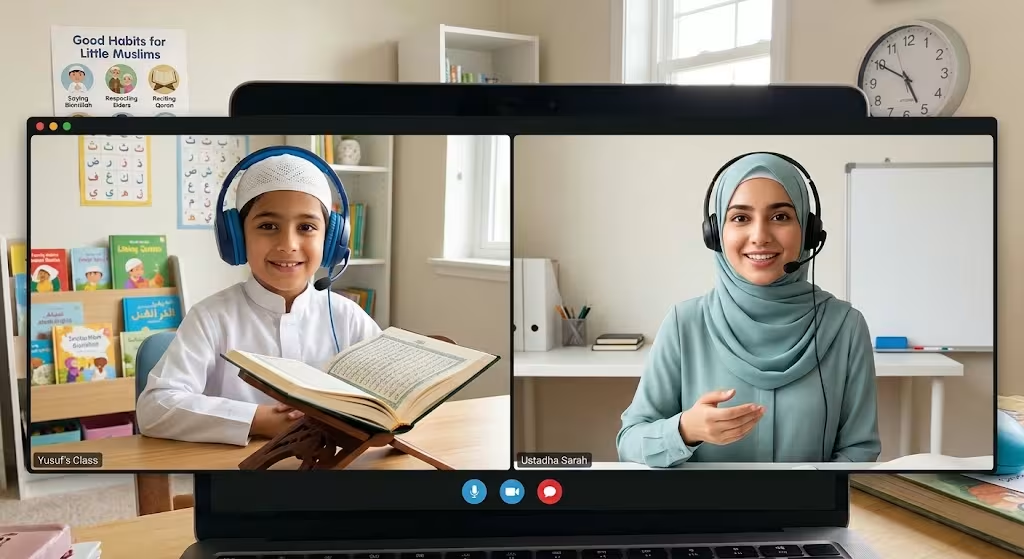
We provide one-to-one Quran lessons for children and teenagers with qualified male and female Quran teachers who understand that every child has a different personality, learning pace, attention span, and educational need.
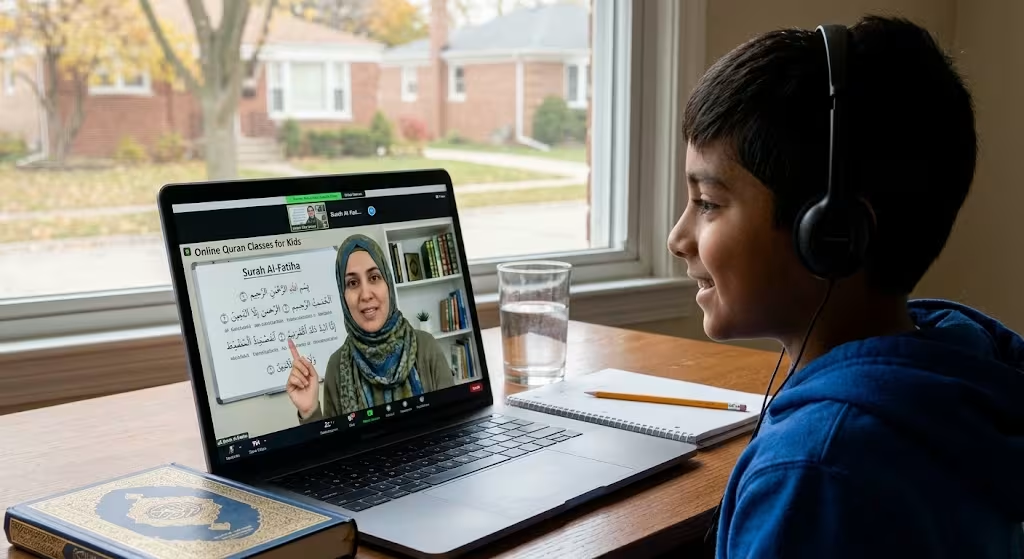
Whether your child is just starting with Noorani Qaida, learning to read the Quran, improving Tajweed, memorizing Surahs, or developing a stronger understanding of Islamic Studies, lessons are structured according to the child's current level and learning goals.
Our aim is simple: help children learn the Quran confidently while developing a positive and lasting relationship with Islam.
From families in Texas and California to Muslim communities in New York, New Jersey, Michigan, Illinois, Ohio, and beyond, our online learning model allows parents to provide consistent Quran education from the comfort of home.
A child should not feel that Quran class is simply another difficult school subject.
Children naturally learn better when they feel comfortable, involved, encouraged, and interested in what they are learning. That is why our online Quran classes for kids are designed to be interactive rather than relying only on repetition and memorization.
Our teachers adjust their teaching style according to the child's age and personality.
For younger children, a lesson may include:
For older children and teenagers, lessons can gradually become more structured and academically focused, including Quran reading, Tajweed, memorization, translation, Tafseer, Hadith, and Islamic Studies.
When a child enjoys the learning experience, consistency becomes easier.
Our goal is not simply to complete pages of a Qaida or Quran. We want children to understand that Quran learning is a meaningful part of their life.
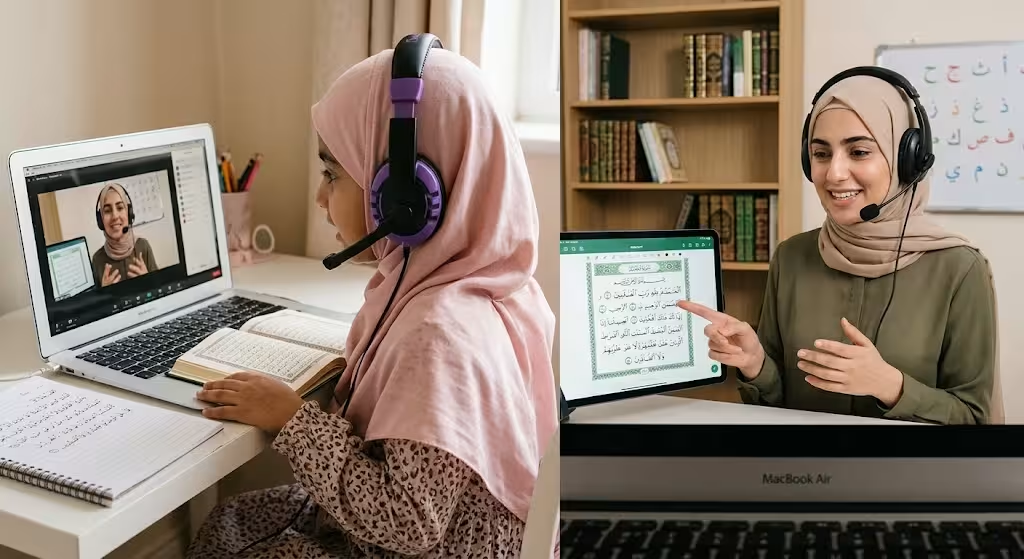
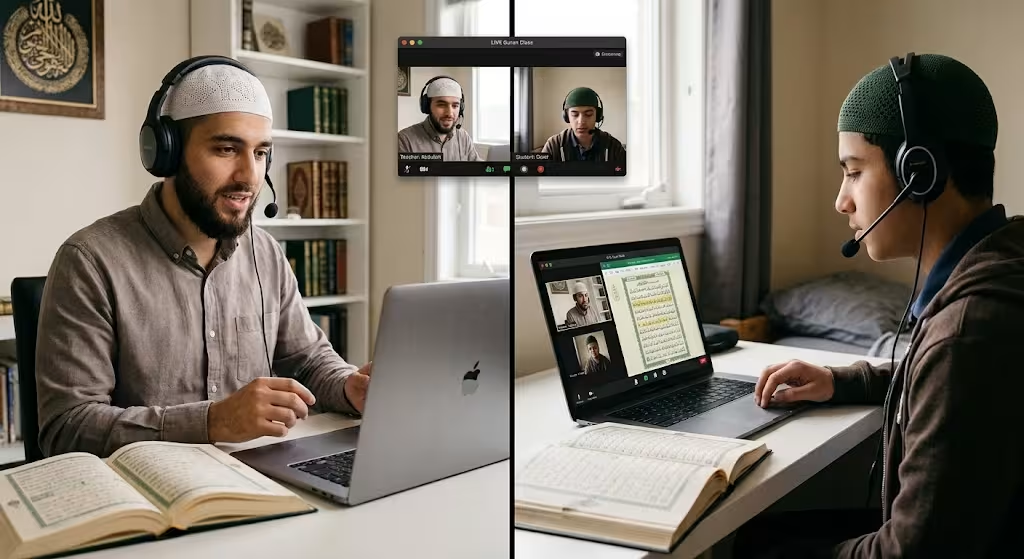
Children do not all need the same Quran course.
A 6-year-old beginner and a 15-year-old teenager may both need Quran education, but their lessons should obviously not look the same.
Our courses can be adapted according to age, current Quran reading ability, previous education, and learning objectives.
Younger learners may begin with:
Teenagers may benefit from a more advanced program covering:
A child who progresses quickly should be able to move forward, while a child who needs more practice should receive additional support rather than being rushed.
One of the biggest differences between teaching an adult and teaching a child is understanding how the child responds to learning.
A teacher may know Quran extremely well, but that alone does not guarantee that they will be the right teacher for a young learner.
Children may become:
Our teachers are expected to approach these situations with patience and encouragement.
Rather than immediately treating a child's behaviour as a lack of interest, teachers should try to understand why the child is struggling to engage.
For example, a shy child may need more encouragement before answering. A distracted child may need shorter learning activities and more interaction. A fast learner may need additional challenges to remain interested.
Because our Quran classes are one-to-one, the teacher can focus on the individual student rather than trying to manage a large classroom.
This gives the teacher more opportunity to:
This personalized approach can make a significant difference in a child's Quran learning experience.
Every parent knows that children can have completely different personalities.
One child may sit quietly and finish a lesson without interruption. Another may move around, lose
That does not necessarily mean the child cannot learn Quran.
Sometimes, the teaching approach needs to change.Some children understand the lesson but hesitate to speak because they are afraid of making mistakes.
Our teachers can create a supportive environment where mistakes are treated as part of learning rather than something embarrassing.
Children with short attention spans often respond better when the lesson contains variety and interaction.
Teachers can use questions, repetition, reading practice, short activities, and age-appropriate examples to bring the child's attention back to the lesson.
A highly energetic child may require a teacher who knows how to keep the lesson structured without making the child feel constantly criticised.
The objective is to maintain classroom discipline while keeping Quran learning positive.
A child who repeatedly hears that they are “slow” or “not paying attention” may gradually lose confidence.
We prefer positive reinforcement: identify what the child is doing correctly, work on one improvement at a time, and celebrate progress.
Children naturally respond to interactive learning.
That is why appropriate game-based activities can be incorporated into lessons where they support the learning objective.
This does not mean turning Quran class into a video game.
Instead, teachers can use simple interactive techniques such as:
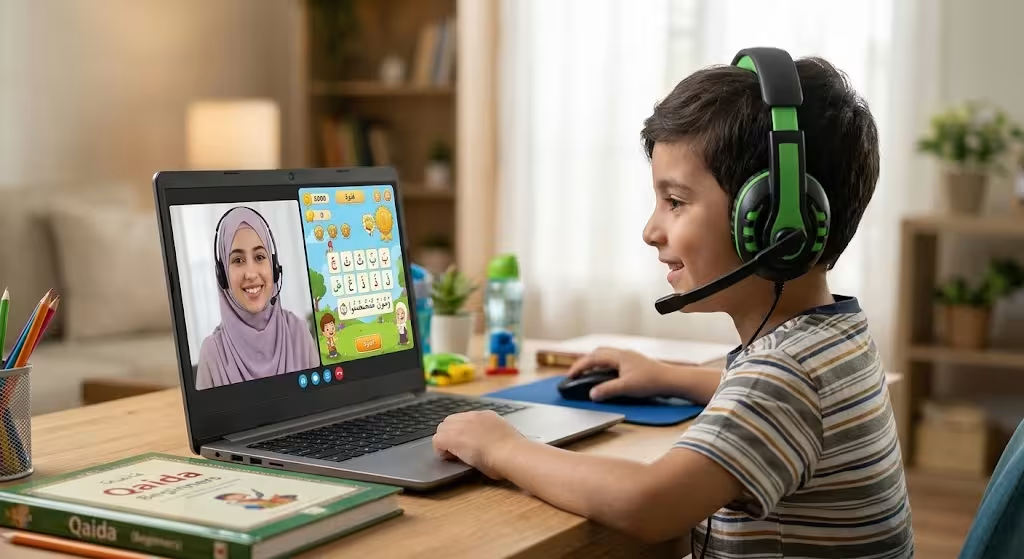
For younger children, these activities can help break the monotony of a traditional lesson.
For teenagers, interactive questioning and practical discussions can make Islamic Studies, Tafseer, Hadith, and Quranic meanings more relevant to their everyday lives.
Our online Quran classes for kids in USA are suitable for different age groups, from young beginners to teenagers.
The learning journey can develop as the child grows.
A younger student might begin by learning Arabic letters and basic reading. Over time, the same student can progress toward fluent Quran reading, Tajweed, memorization, translation, Tafseer, and deeper Islamic knowledge.
The exact route depends on the child's ability and goals.
Not every child learns at the same speed.
Some children need more repetition. Others learn very quickly. Some remember what they hear, while others benefit more from seeing examples and practising repeatedly.
This is why we avoid assuming that one teaching method will work equally well for every student.
During the learning process, teachers can identify areas where a child needs additional support.
Instead of simply moving forward because the scheduled lesson is finished, the teacher can revisit the difficult area and provide additional practice.
Parents should be able to see that their child's Quran education is progressing based on actual ability—not simply the number of pages completed.
For parents in the United States, choosing an online Quran academy is also about trust, safety, professionalism, and communication.
Parents want to know who is teaching their child, how the class is conducted, and whether their child's learning progress is being monitored.
Our one-to-one online classes allow children to learn from home through a familiar digital environment.
Families can schedule lessons around school, homework, sports, family activities, and other commitments.
This is particularly useful for Muslim families living in areas where finding a convenient local Quran teacher may not always be easy.
Children can attend their lesson from home, which can be particularly helpful for younger or shy learners.
Parents can also remain aware of the child's class routine and progress.
Our aim is to provide a professional learning environment that feels comfortable for both American Muslim families and their children.
Quran education should not stop at reading Arabic words.
Children also need to understand how Islamic teachings connect with everyday life.
That is why age-appropriate Islamic Studies can be included alongside Quran learning.
Children may learn about:
For younger children, these concepts can be introduced through simple examples and stories.
For teenagers, discussions can become more mature and connected to real-life situations they encounter at school, with friends, online, and within their communities.
Every child starts from a different point.
Before recommending a course, it is important to understand where the child currently stands.
For example:
Knows Arabic letters but cannot join them confidently.
Reads Quran but struggles with Tajweed.
Reads well and wants to start Hifz.
Has previously studied Quran but needs a more engaging teacher.
Is a teenager looking for Tafseer and deeper Islamic understanding.
These children should not all receive the same lesson plan.
Our one-to-one model allows teachers to work according to the student's current level and objectives.
Choosing a Quran teacher is an important decision, especially when the student is a child.
That is why we offer a free trial class for your child so parents can experience the teaching approach before making a commitment.
During the registration process, parents can share basic information such as:
The teacher gets an opportunity to assess the child's current level.
Depending on the child's age, the assessment may include Arabic letters, Qaida, Quran reading, pronunciation, Tajweed, memorization, or Islamic Studies.
The trial is also an opportunity to observe how the child responds to the teacher.
After the assessment, we can recommend an appropriate learning path based on the child's level and goals.
Parents do not need to guess whether their child should start with Qaida, Quran reading, Tajweed, Hifz, or another course.
Once the family decides to continue, the teacher follows a structured learning plan with regular revision and progress monitoring.
Choosing an online Quran academy is ultimately a decision about trust.
Parents want qualified teachers, structured lessons, consistent communication, and an educational environment where their children can learn comfortably.
At QuraanClasses.us, our child-focused approach combines:
Your child receives focused attention from the teacher.
Families can choose a teacher according to their preferences and child's requirements.
A young child and a teenager should not receive identical lessons.
Lessons follow a learning path based on the student's level and goals.
Teachers identify and correct reading mistakes during lessons.
Children can learn practical Islamic knowledge alongside Quran.
Questions, activities, revision, and appropriate game-based learning can keep children engaged.
Students are encouraged to improve rather than simply complete lessons.
Children can learn from home without travelling to a Quran center.
Your child's relationship with the Quran can begin with something as simple as learning the Arabic alphabet.
With the right teacher, that first step can eventually lead to confident Quran reading, beautiful Tajweed, memorization, understanding of Quranic meanings, and a stronger connection with Islam.
Whether your child is 4, 7, 10, 13, or 16, the right approach should be based on the learner—not simply their age.
If you are looking for online Quran classes for kids in USA, we would be happy to assess your child's current level and recommend a suitable learning path.
Book a free trial Quran class for your child today.
Give your child the opportunity to learn the Quran with confidence, consistency, and a teaching approach designed around children.
Choose the plan that fits your schedule - flexible, affordable, one-to-one
Per Month
Per Month
Per Month
Have a question or just want to say hi? We'd love to hear from you.


We are available 24/7 for admissions