



The best Qaris for learning recitation are the ones who read slowly, clearly and in the Hafs 'an Asim narration most Muslims in the USA use. For beginners, Mahmoud Khalil Al-Husary and Muhammad Siddiq Al-Minshawi are the top choices, especially their teaching (muallim) recordings with pauses to repeat. Abdullah Basfar and Ayman Suwaid suit improving readers. Saad Al-Ghamdi, Mishary Alafasy and Maher Al-Muaiqly suit fluent readers and Hifz students.
Ask ten Muslims who their favorite reciter is and you will get ten answers. Ask a Quran teacher which Qaris for learning recitation they recommend, and the list becomes much shorter. A beautiful voice moves the heart, but a learner needs something different: a reciter whose letters, lengths and stops are clear enough to copy.
Most "best Quran reciters" lists rank voices by fame. This guide ranks them by usefulness for learning. You will see which Qaris for learning recitation fit a beginner, an improving reader and a Hifz student, what to listen for, and a simple four-week plan that fits a US school or work week.
Why Listening to a Qari Matters
Recitation is an oral tradition. The Prophet Muhammad (peace be upon him) received the Quran from Jibreel and taught it by recitation, and his Companions learned it the same way, by listening and repeating. Allah says "and recite the Quran with measured recitation" (Surah Al-Muzzammil 73:4), and also "when the Quran is recited, listen to it and pay attention" (Surah Al-A'raf 7:204).
Listening trains three things that a book cannot:
- Your ear. You learn what a correct letter, a two-count madd or a nasal ghunnah actually sounds like.
- Your rhythm. You absorb where reciters stop, where they breathe and how they start again.
- Your confidence. Familiar verses are far easier to read aloud in Salah or in front of a teacher.
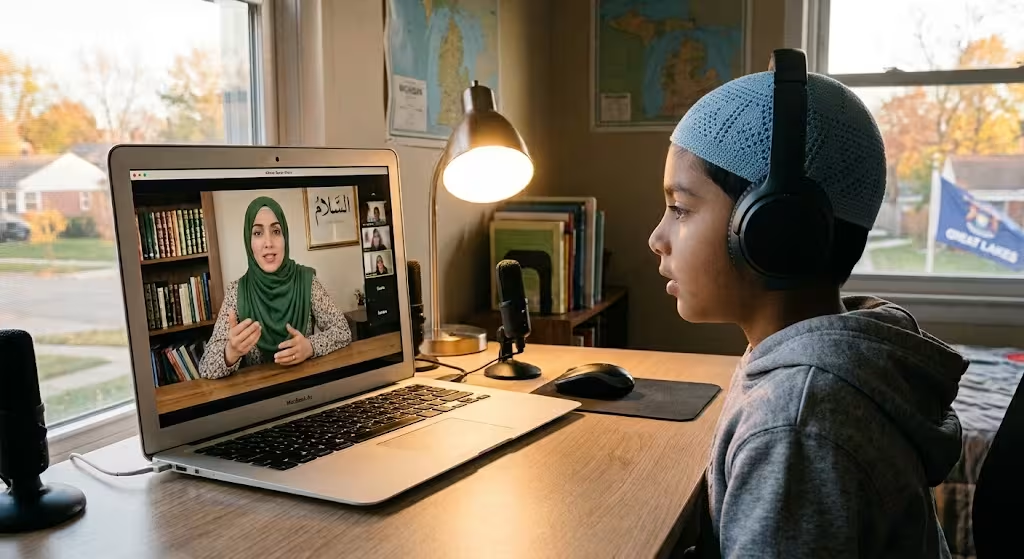
The Prophet (peace be upon him) also said, "He is not one of us who does not recite the Quran in a pleasant voice" (Sahih al-Bukhari). Copying a skilled reciter is the natural first step toward that goal. The goal, though, is your own correct recitation, not an imitation of someone's voice. That is why listening works best alongside a teacher in Quran recitation classes online, who checks that what you copied is what you actually say.
What Makes Good Qaris for Learning Recitation?
Before the list, here are the five things that separate good Qaris for learning recitation from voices that are simply beautiful to listen to:
- Narration (riwayah). Choose a recording in Hafs 'an Asim, the narration printed in almost every Mushaf in the USA. Some famous reciters also recorded Warsh or other narrations, so check the label.
- Speed. Recitation has three common speeds: Tahqiq (very slow and precise), Tadweer (medium) and Hadr (fast). Beginners need Tahqiq or a slow Tadweer.
- Style. A murattal recording is plain, even reading. A mujawwad recording is slow and melodic with long breaths and repeated phrases. Murattal is easier to copy.
- Clear letters. Every makhraj should be audible, including heavy letters and the letters that come from the throat.
- Consistency. The same madd should get the same length every time, so your ear learns a stable pattern.
The 10 Best Qaris for Learning Recitation
1. Mahmoud Khalil Al-Husary (Egypt)
Sheikh Al-Husary (1917-1980) is the reciter Tajweed teachers recommend most often. His murattal is slow, steady and exact, and every rule is easy to hear. He also recorded a teaching (muallim) version in which he recites a short section and then pauses so the listener can repeat it. For a beginner, this is the closest thing to a teacher on audio.
2. Muhammad Siddiq Al-Minshawi (Egypt)
Sheikh Al-Minshawi (1920-1969) has a warm, humble voice and very clean pronunciation. His murattal is excellent for copying, and his teaching recording with children repeating after him is a favorite with families. His mujawwad recordings are more emotional, so save those for later.
3. Abdullah Basfar (Saudi Arabia)
Sheikh Basfar reads at a calm, even pace that is easy to follow. His recording paired with an English translation is useful for American families who want children to hear the meaning after each verse.
4. Ayman Suwaid (Syria)
Dr. Ayman Suwaid is known worldwide for his televised Tajweed lessons. His recitation is measured and textbook-clear, which makes it ideal once you start studying the rules.
5. Abdul Basit Abdus-Samad (Egypt)
Sheikh Abdul Basit (1927-1988) is one of the most loved voices in history. His murattal is suitable for intermediate learners; his famous mujawwad, with very long breaths, is better for inspiration than for copying.
6. Saad Al-Ghamdi (Saudi Arabia)
A steady medium pace with clear stops. Many Hifz students use him because one page sounds the same every time they replay it.
7. Mishary Rashid Alafasy (Kuwait)
Clear, modern and popular with children and teens. His recordings of the short surahs are a good bridge for young learners moving from Juz Amma to longer reading.
8. Maher Al-Muaiqly (Saudi Arabia)
An imam of Masjid al-Haram in Makkah with a measured, smooth Tadweer. Good for improving readers who want to build flow.
9. Abdul Rahman Al-Sudais (Saudi Arabia)
The long-serving imam of Masjid al-Haram. His style is faster and very recognizable. It suits revision for fluent readers more than first-time learning.
10. Saud Al-Shuraim (Saudi Arabia)
Another former Makkah imam with a quick, powerful Hadr. Excellent for revising a page you already know, not for learning new letters.
Qaris for Learning Recitation by Level
The table below matches each level to the Qaris for learning recitation that fit it best, and to the type of recording to search for.
| Your level | Best Qaris to start with | Recording to look for | Pace |
|---|---|---|---|
| Beginner (Qaida, first surahs) | Al-Husary, Al-Minshawi | Muallim (teaching, with repeat pauses) | Tahqiq |
| Child learner (ages 5-10) | Al-Minshawi, Alafasy | Teaching recording, short surahs | Slow |
| Improving reader | Basfar, Ayman Suwaid, Al-Husary | Murattal | Slow Tadweer |
| Fluent reader | Abdul Basit (murattal), Al-Muaiqly | Murattal | Tadweer |
| Hifz student | Al-Ghamdi, Al-Husary, Alafasy | Murattal, page by page | Tadweer |
| Revision and Salah practice | Al-Sudais, Al-Shuraim | Murattal | Hadr |
A simple rule: the newer you are, the slower your Qari should be. If you are still learning the letters, read our guide to the Arabic alphabet for Quran beginners first, then add Al-Husary's teaching recording.
How to Use Qaris for Learning Recitation: A 4-Week Plan
Busy families in the USA rarely have a free hour. This plan uses 15 minutes a day and fits a school or work week, whether you are on Eastern, Central, Mountain or Pacific time.
- Week 1: Listen only. Pick one short surah and one Qari. Play it on the drive to school or work and once at home with the Mushaf open, following each word with your finger.
- Week 2: Listen, pause, repeat. Use a teaching recording or pause after each verse. Repeat it out loud, matching the lengths and stops, not the voice.
- Week 3: Shadow. Recite at the same time as the Qari, just a fraction behind. This trains your tongue to keep his rhythm.
- Week 4: Record and compare. Record yourself on your phone, then play the Qari and your recording back to back. Write down the two biggest differences and work on them.
Our article with 10 exercises to improve Quran recitation gives drills for the gaps you find in week 4, and our guide on how to read Quran fluently helps once your pace is steady.
Where to Find These Recordings
You do not need to buy anything. Free Quran websites and apps such as Quran.com let you choose the reciter, play verse by verse and repeat a single ayah as many times as you like. When you search, add the word "muallim" or "teaching" to find the slow learner versions, and check that the recording says Hafs. Download the surah you are studying so it plays offline in the car or on the school bus. Keep a short playlist of two or three Qaris for learning recitation, not twenty, so your ear gets used to one clear model.
What to Listen For in Each Verse
When you play one of these Qaris for learning recitation, listen for one thing at a time instead of everything at once:
- Madd lengths. Count the long vowels. A natural madd is 2 counts; our Madd rules guide lists the rest.
- Ghunnah. Notice the two-count nasal sound on a noon or meem with shaddah.
- Heavy and light letters. Hear how the heavy letters fill the mouth while the light ones stay thin.
- Stops and starts. Watch where the Qari pauses and from which word he restarts.
- Qalqalah. Listen for the light echo on the five qalqalah letters with sukoon.
Common Mistakes With Qaris for Learning Recitation
- Choosing by voice alone. A Qari you love is wonderful for motivation, but your study recording should be slow and clear.
- Copying the melody before the letters. Maqam and tone come last. Correct sounds come first.
- Starting with mujawwad or fast Hadr. You cannot copy what you cannot follow.
- Mixing narrations. Listening in Warsh while reading a Hafs Mushaf confuses beginners.
- Never checking yourself. You cannot fully hear your own mistakes. A teacher can.
- Switching Qaris every week. Stay with one reciter for a surah until it sounds natural.
Can Listening Replace a Teacher?
No. Listening to Qaris for learning recitation trains your ear, but it cannot tell you when your own throat letters are too light or your madd is a count short. Scholars of Tajweed have always stressed learning by talaqqi: reciting directly to a qualified teacher who listens and corrects. The best combination is a Qari at home and a teacher every week. Our Quran Reading and Tajweed course follows exactly this method.
Families from Texas and Houston to Illinois and Chicago book short one-to-one lessons after school, after work or on weekends. A teacher listens to the same surah you have been practicing with your chosen Qaris for learning recitation and gives you clear corrections. Explore our online Quran classes in USA and start with a free trial.