


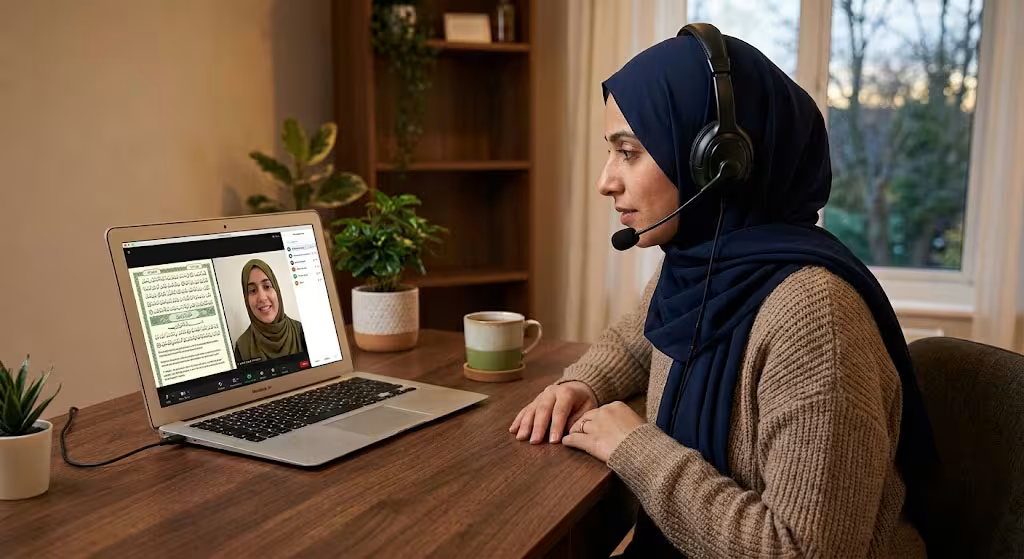
Hifz for women is fully possible alongside motherhood, work and study. Most busy moms memorize with a female teacher in two or three 30 minute online lessons a week and 20 to 30 minutes of daily practice. At half a page a day, five days a week, the whole Quran takes about five years; at one page a day, about two and a half. Steady daily revision matters more than speed.
Many sisters carry a quiet dream of becoming a Hafizah. Then come marriage, children, a job, school runs and dinner, and the dream starts to feel like something for teenagers in a full-time madrasah, not for a 35-year-old mom in Houston or New Jersey.
It is not. Allah says, "And We have certainly made the Quran easy for remembrance, so is there any who will remember?" (Surah Al-Qamar 54:17). This guide on Hifz for women gives you what most program pages leave out: real timelines by pages per day, a daily routine built around a family, a revision system that stops you from forgetting, honest guidance for period, pregnancy and postpartum days, and how to choose the right female teacher.
Why Hifz for Women Looks Different
Women memorize just as well as men. What changes is the shape of the day. A mother's time comes in small, unpredictable pieces: 20 minutes while the baby naps, 15 minutes before school pickup, half an hour after Isha. A plan built for a full-time student breaks within a week.
Women also face things a general Hifz program rarely plans for: monthly cycles, pregnancy, newborn months and seasons when family needs come first. A good plan for Hifz for women expects these and builds around them, so a hard month becomes a slower month, not the end of the journey.
That is why Hifz for women usually works best with private, one-to-one lessons and a female teacher. Our online Quran classes for ladies are built this way: flexible times, the camera optional and a Hafizah who knows that a lesson may include a toddler on your lap.
Hifz for women also has a long history to draw strength from. Many women among the Companions knew large parts of the Quran by heart, and the first complete written collection of the Quran, compiled under Abu Bakr, was later kept with Hafsah bint Umar, the Mother of the Believers (Sahih al-Bukhari). Women have always been guardians of the Quran.
How Long Does Hifz for Women Take?
The standard Madani Mushaf has 604 pages of 15 lines each, in 30 Juz. Your timeline depends on how much new memorization (Sabaq) you do each day and how many days a week you memorize. The table below shows typical Hifz for women timelines, assuming five memorization days a week, with the other days kept for revision only.
| New memorization per day | Per week (5 days) | One Juz (about 20 pages) | Whole Quran |
|---|---|---|---|
| 3 lines (1/5 page) | 1 page | about 5 months | about 11.5 years |
| 5 lines (1/3 page) | about 1.7 pages | about 3 months | about 7 years |
| 7 to 8 lines (1/2 page) | 2.5 pages | about 8 weeks | about 4.6 years |
| 1 page | 5 pages | about 4 weeks | about 2.3 years |
| 2 pages | 10 pages | about 2 weeks | about 1.2 years |
Add time for holidays, illness, travel and new babies. For most mothers, half a page a day is the sweet spot: small enough to finish in 20 minutes, big enough to see steady progress. Hifz for women is not a race, and completing Juz Amma, Surah Al-Mulk or a handful of Juz is a real achievement in its own right.
If you are unsure whether to go slow or fast, our guide to a part-time vs full-time Hifz program compares both paths.
Hifz for Women Readiness Check: 4 Steps Before You Start
- Can you read fluently from the Mushaf? You do not need to be perfect, but you should read without spelling out letters. If not, spend a few months on reading and Tajweed first.
- Is your Tajweed reasonably correct? Mistakes you memorize are very hard to unlearn. A teacher will fix pronunciation while you memorize, but the basics should be in place.
- Do you have one fixed daily slot? Even 20 minutes, at the same time each day, anchored to a routine like Fajr or school drop-off.
- Have you chosen a Mushaf and stayed with it? Use one printed copy (ideally a 15-line Madani Mushaf) so your visual memory of each page stays stable.
A Daily Routine for Hifz for Women With Busy Days
Every successful plan for Hifz for women rests on three parts used by Hifz teachers for generations: Sabaq (new lesson), Sabqi (the last few days or weeks of memorization) and Manzil (older portions, rotated). Here is how that looks in a mother's day:
| Time | What you do | Minutes |
|---|---|---|
| After Fajr | Memorize today's Sabaq (half a page) | 15 to 20 |
| During chores or the school run | Listen to today's page by one reciter | 5 to 10 |
| Nap time or lunch break | Recite Sabqi: the last 5 to 7 days of new pages | 10 to 15 |
| In Sunnah or Nafl prayers | Recite part of your Manzil | 5 to 10 |
| After Isha, 2 or 3 nights a week | Online lesson with your female teacher | 30 |
The memorizing method itself is simple:
- Listen to the page two or three times while following the text.
- Read one verse five to ten times while looking, then recite it five times without looking.
- Add the next verse, then join the two together.
- Continue to the end of your portion, then recite the full portion three times from memory.
- Recite it to your teacher at your next lesson before moving on.
For more techniques, see our guide on how to memorize the Quran and never forget.

Hifz Revision Plan: Stop Forgetting What You Memorized
The Prophet ﷺ told his Companions to keep revisiting the Quran, because it slips away from memory faster than a camel slips free from its rope (Sahih al-Bukhari and Sahih Muslim). For a mom with little time, revision is where Hifz for women is won or lost.
A simple rule: never let your new memorization outgrow your revision. A good Hifz revision plan looks like this:
- Under 2 Juz memorized: revise everything at least once a week.
- 2 to 5 Juz: revise half a Juz to one Juz of Manzil a day, so everything rotates every one to two weeks.
- 5 Juz and above: revise one Juz a day; on very busy days, stop new memorization before you drop revision.
- One day a week with no Sabaq at all: use it to catch up on revision and fix weak pages.
Mark weak spots in pencil in your Mushaf and recite those pages to your teacher. Reciting a page in your Sunnah prayers is the strongest test.
Hifz for Women During Periods, Pregnancy and Postpartum
This is the question almost every sister asks, and most Hifz programs never answer it.
During menstruation: scholars differ. The majority (the Hanafi, Shafi'i and Hanbali schools) hold that a woman should not recite the Quran aloud during her period. The Maliki school, and scholars such as Ibn Taymiyyah, allow reciting from memory, especially when there is a need such as teaching or fear of forgetting. Most scholars hold that touching the Mushaf itself requires purity. Follow a scholar you trust, and tell your teacher so she can plan around it.
Whatever view you follow, these days do not have to stop your Hifz for women plan. Activities nearly all scholars allow include:
- Listening to your Sabqi and Manzil recited by a Qari.
- Going over verses in your mind without moving your tongue.
- Studying the meaning and Tafseer of the Surahs you are memorizing.
- Planning the next week's pages with your teacher.
Pregnancy: many women find the second trimester the best time to memorize steadily. In the first and third trimesters, lower your Sabaq and protect revision.
After birth: the first weeks are for recovery. Revision by listening during night feeds keeps the Quran close. When you are ready, restart with a smaller Sabaq, like three lines a day, and build back up. A pause in Hifz for women is not a failure.
Common Mistakes in Hifz for Women
- Starting too big: a page a day sounds inspiring but often collapses within a month. Start small and grow.
- Skipping revision for new pages: the fastest way to lose what you worked hard for.
- Changing Mushaf copies: your memory is visual; keep one copy.
- Memorizing without a teacher: small Tajweed errors become permanent habits.
- Comparing yourself to others: a single mom working full time and a stay-at-home mom with one child will not move at the same speed, and both are earning reward. The Prophet ﷺ said the one who recites the Quran with difficulty gets two rewards (Sahih al-Bukhari and Sahih Muslim).
- Quitting after a hard month: reduce the load instead of stopping.
How to Choose an Online Hifz Teacher as a Woman
Online Hifz classes for sisters work best when the teacher fits your life as well as your level. In Hifz for women, the teacher is often the difference between finishing and quitting. Look for:
- A qualified female Hafizah, ideally with Ijazah, and strong Tajweed. Our guide to find a female Quran teacher online lists the questions to ask.
- Times in your US time zone. A mom in Dallas on Central Time and a mom in Virginia on Eastern Time should both get a slot that suits their house, early morning or late evening.
- A written plan with your daily Sabaq, Sabqi and Manzil, and regular progress checks.
- Flexibility for sick kids, period days and new babies, with easy rescheduling.
- Privacy: one-to-one lessons with the camera optional.
You can meet our female Quran teachers in a free trial, and see the full structure of our Quran memorization course, from short Surahs to the full Quran.
Hifz for Women Across the USA
We teach mothers and working women in every state, from online Quran classes in Texas and Houston to busy families in New Jersey and Illinois. Many of them started Hifz for women in their thirties or forties, often alongside their children. If your days are already full, our guide to online Quran classes for moms shows how other mothers fit lessons around school and work.
Ready to begin? Explore our Quran classes for women with a female teacher, compare all our online Quran classes in USA, and book a free trial. Plans start at $40 per month for three 30 minute lessons a week.