



The best short duas for kids to memorize first are the ones they can use every day: Bismillah before eating, Alhamdulillah after eating, the dua before sleeping (Bismika Allahumma amutu wa ahya), the dua on waking up, the dua for leaving home, Rabbi zidni 'ilma for knowledge and Rabbir-hamhuma for parents. Teach one dua a week, link it to its daily moment, explain the meaning in one sentence and say it together until it becomes a habit.
Most Muslim parents want the same thing: a child who turns to Allah naturally, not only during prayer but while eating breakfast, buckling into the car or getting ready for bed. Short duas for kids are the easiest way to build that habit, because every dua is tied to a moment that already happens every day.
The problem is that most lists online simply copy ten duas onto a page. They rarely tell you which ones to start with, how many a five-year-old can handle, or how to fit them into a busy American school day. This guide gives you 15 short duas with Arabic, easy transliteration, meaning and source, an age-by-age plan, a sample routine for a US school day and the mistakes that slow children down.
Why Teach Duas for Kids So Early?
The Prophet ﷺ said, "Dua is worship" (Sunan Abu Dawud and Jami' at-Tirmidhi). When a child says Bismillah before a meal, they are worshipping Allah in a simple, natural way, many times a day.
He ﷺ also taught children directly. When the young Umar ibn Abi Salamah was eating, the Prophet ﷺ gently told him, "Young boy, mention the name of Allah, eat with your right hand, and eat from what is in front of you" (Sahih al-Bukhari and Sahih Muslim). He taught the young Ibn Abbas, "When you ask, ask Allah, and when you seek help, seek help from Allah" (Jami' at-Tirmidhi). Teaching daily duas for kids follows that same gentle, practical method: a short phrase, taught at the right moment, with love.
Duas also build Arabic and Quran skills. Many of the duas below come straight from the Quran, so a child who memorizes them is already memorizing verses. If your child is also learning to read, our online Quran classes for kids teach Qaida, short Surahs and everyday duas side by side, so each one supports the other.
15 Short Duas for Kids to Memorize
The list moves from the shortest, most-used duas to slightly longer ones. Start at the top and move down only when the earlier ones are solid. Transliteration is simplified for young readers; a teacher can polish the pronunciation later.
Mealtime Duas for Kids
1. Before eating بِسْمِ اللَّهِ (Bismillah) *Meaning:* In the name of Allah. *Source:* Sahih al-Bukhari and Sahih Muslim. If your child forgets at the start, they can say Bismillahi awwalahu wa akhirahu (In the name of Allah, at its beginning and its end), from Abu Dawud and at-Tirmidhi.
2. After eating الْحَمْدُ لِلَّهِ الَّذِي أَطْعَمَنِي هَذَا وَرَزَقَنِيهِ مِنْ غَيْرِ حَوْلٍ مِنِّي وَلَا قُوَّةٍ (Alhamdu lillahil-ladhi at'amani hadha wa razaqanihi min ghayri hawlin minni wa la quwwah) *Meaning:* All praise is for Allah, who fed me this and provided it for me without any power or strength from me. *Source:* Abu Dawud and at-Tirmidhi. Toddlers can start with just Alhamdulillah and grow into the full dua.
Bedtime and Morning Duas for Kids
3. Before sleeping بِاسْمِكَ اللَّهُمَّ أَمُوتُ وَأَحْيَا (Bismika Allahumma amutu wa ahya) *Meaning:* In Your name, O Allah, I die and I live. *Source:* Sahih al-Bukhari. This is one of the easiest bedtime duas for kids because it is only four words.
4. On waking up الْحَمْدُ لِلَّهِ الَّذِي أَحْيَانَا بَعْدَ مَا أَمَاتَنَا وَإِلَيْهِ النُّشُورُ (Alhamdu lillahil-ladhi ahyana ba'da ma amatana wa ilayhin-nushur) *Meaning:* All praise is for Allah, who gave us life after He caused us to die, and to Him is the return. *Source:* Sahih al-Bukhari.
5. Bedtime protection: the three Quls The Prophet ﷺ would recite Surah Al-Ikhlas, Al-Falaq and An-Nas each night, blow into his hands and wipe over his body (Sahih al-Bukhari). Children who already know these short Surahs can make this part of bedtime. Older kids can add Ayat al-Kursi; our Ayat al-Kursi meaning guide explains it in simple English.
Duas for Home, Car and Bathroom
6. Leaving home بِسْمِ اللَّهِ تَوَكَّلْتُ عَلَى اللَّهِ وَلَا حَوْلَ وَلَا قُوَّةَ إِلَّا بِاللَّهِ (Bismillah, tawakkaltu 'alallah, wa la hawla wa la quwwata illa billah) *Meaning:* In the name of Allah, I put my trust in Allah, and there is no power and no strength except with Allah. *Source:* Abu Dawud and at-Tirmidhi.
7. Getting into the car (travel dua) سُبْحَانَ الَّذِي سَخَّرَ لَنَا هَذَا وَمَا كُنَّا لَهُ مُقْرِنِينَ وَإِنَّا إِلَى رَبِّنَا لَمُنْقَلِبُونَ (Subhanal-ladhi sakhkhara lana hadha wa ma kunna lahu muqrinin, wa inna ila rabbina lamunqalibun) *Meaning:* Glory be to the One who made this of service to us, for we could never have done it ourselves, and to our Lord we will surely return. *Source:* Surah Az-Zukhruf 43:13-14. For American families who spend a lot of time in the car, the daily school drop-off is a perfect place to practice it.
8. Entering the bathroom اللَّهُمَّ إِنِّي أَعُوذُ بِكَ مِنَ الْخُبُثِ وَالْخَبَائِثِ (Allahumma inni a'udhu bika minal-khubuthi wal-khaba'ith) *Meaning:* O Allah, I seek refuge with You from all evil and evil beings. *Source:* Sahih al-Bukhari and Sahih Muslim. Teach it at the door, before going in.
9. Leaving the bathroom غُفْرَانَكَ (Ghufranak) *Meaning:* I ask for Your forgiveness. *Source:* Abu Dawud and at-Tirmidhi. One word, which makes it a quick early win.
Duas From the Quran for School, Family and Feelings
10. For knowledge رَبِّ زِدْنِي عِلْمًا (Rabbi zidni 'ilma) *Meaning:* My Lord, increase me in knowledge. *Source:* Surah Ta-Ha 20:114. Perfect before homework, a spelling test or Quran class.
11. For ease before something hard رَبِّ اشْرَحْ لِي صَدْرِي وَيَسِّرْ لِي أَمْرِي (Rabbish-rahli sadri wa yassirli amri) *Meaning:* My Lord, open my heart and make my task easy for me. *Source:* Surah Ta-Ha 20:25-26, the dua of Prophet Musa. Children love hearing that a Prophet was nervous about speaking too.
12. For parents رَبِّ ارْحَمْهُمَا كَمَا رَبَّيَانِي صَغِيرًا (Rabbir-hamhuma kama rabbayani saghira) *Meaning:* My Lord, have mercy on them as they raised me when I was small. *Source:* Surah Al-Isra 17:24.
13. For good in this life and the next رَبَّنَا آتِنَا فِي الدُّنْيَا حَسَنَةً وَفِي الْآخِرَةِ حَسَنَةً وَقِنَا عَذَابَ النَّارِ (Rabbana atina fid-dunya hasanatan wa fil-akhirati hasanatan wa qina 'adhaban-nar) *Meaning:* Our Lord, give us good in this world and good in the Hereafter, and protect us from the punishment of the Fire. *Source:* Surah Al-Baqarah 2:201.
14. When scared or worried حَسْبُنَا اللَّهُ وَنِعْمَ الْوَكِيلُ (Hasbunallahu wa ni'mal-wakil) *Meaning:* Allah is enough for us, and He is the best One to trust. *Source:* Surah Al Imran 3:173. Useful after a bad dream, before a doctor visit or on the first day at a new school.
15. When sneezing The child says Alhamdulillah, the listener replies Yarhamukallah (May Allah have mercy on you), and the child answers Yahdikumullahu wa yuslihu balakum (May Allah guide you and set your affairs right). *Source:* Sahih al-Bukhari. Kids enjoy this one because it is a conversation.
Quick Reference Table: Duas for Kids at a Glance
Print this table and stick it on the fridge. It shows when to say each dua, how long it is and roughly when most children are ready for it.
| # | Dua | When to say it | Length | Ready from age |
|---|---|---|---|---|
| 1 | Bismillah | Before eating, starting anything | 1 word | 2-3 |
| 2 | Alhamdulillah (full dua later) | After eating | 1 word / 1 line | 2-3 / 6+ |
| 3 | Bismika Allahumma amutu wa ahya | Before sleeping | 4 words | 3-4 |
| 9 | Ghufranak | Leaving the bathroom | 1 word | 3-4 |
| 15 | Sneezing duas | When sneezing | 3 short lines | 4-5 |
| 10 | Rabbi zidni 'ilma | Before study or class | 3 words | 4-5 |
| 4 | Waking-up dua | On waking | 1 line | 5-6 |
| 8 | Bathroom entry dua | Before entering | 1 line | 5-6 |
| 12 | Rabbir-hamhuma | For parents, after prayer | 1 line | 5-6 |
| 6 | Leaving-home dua | At the front door | 1 line | 6-7 |
| 14 | Hasbunallahu wa ni'mal-wakil | When scared or worried | 4 words | 6-7 |
| 11 | Rabbish-rahli sadri | Before tests, speaking | 1 line | 7-8 |
| 13 | Rabbana atina | After prayer, any time | 1 line | 7-8 |
| 7 | Car / travel dua | Starting a car ride | 2 lines | 8+ |
| 5 | Three Quls at bedtime | Before sleeping | 3 short Surahs | 6+ (once memorized) |
A Dua Routine for a US School Day
The easiest way to teach duas for kids is to attach each one to a moment that already happens. Here is how a typical weekday in an American family can carry seven or eight duas without adding a single extra minute:
| Time (your local time) | Moment | Dua |
|---|---|---|
| 6:45 a.m. | Waking up | Waking-up dua |
| 7:15 a.m. | Breakfast | Bismillah, then Alhamdulillah |
| 7:40 a.m. | Leaving for the bus or carpool | Leaving-home dua, car dua |
| 8:00 a.m. | Walking into school | Rabbi zidni 'ilma |
| 3:30 p.m. | After-school snack | Bismillah, Alhamdulillah |
| 4:30 p.m. | Homework or Quran class | Rabbish-rahli sadri |
| 8:00 p.m. | Bedtime | Three Quls, then Bismika Allahumma |
Whether you live in Eastern or Pacific time, the pattern stays the same. If evenings are full with sports and homework, our guide on how kids balance school and Quran learning shows how other US families make room.
How to Teach Duas for Kids: A 5-Step Method
- Pick one dua for the week. Start with the moment that happens most, usually meals or bedtime.
- Tell the meaning first. One sentence is enough: "Before we sleep, we tell Allah that we live and die by His name."
- Say it together, in small chunks. Break longer duas into two or three parts and echo each part, like a call and response.
- Practice at the real moment. Say the dua before every meal that week, not at a separate "dua time." The moment becomes the reminder.
- Let your child lead. By the end of the week, your child says it first and you echo. Then add the next dua and keep reviewing the old ones.
This gentle repetition is the same method good teachers use for short Surahs; our Quran memorization tips for kids go deeper into review cycles and rewards.
Age-by-Age Plan for Duas for Kids
| Age | Realistic goal | Best approach |
|---|---|---|
| 2-3 | Bismillah, Alhamdulillah | Hear it from you at every meal |
| 4-5 | 4-6 one-line duas | Songs, echoing, a sticker chart |
| 6-8 | 10-12 duas with meanings | One dua a week, simple meanings |
| 9-12 | All 15 plus morning and evening adhkar | Arabic reading, Quran references, leading the family |
Do not worry if your child is "behind" this table. Steady progress matters more than speed. If you are unsure when to start formal lessons, read what age a child should start learning Quran.
Common Mistakes When Teaching Duas for Kids
- Teaching too many at once. Ten duas in a month usually means ten half-remembered duas.
- Skipping the meaning. A child who knows what they are saying is far more likely to say it from the heart.
- Only using transliteration. It is a helpful bridge, but the long-term goal is reading the Arabic. Our Noorani Qaida lessons build that reading skill step by step.
- Correcting harshly. Fix pronunciation gently and later; first build the habit.
- Forgetting that dua can also be personal. Alongside these memorized duas, encourage your child to ask Allah for anything in their own words, in English or Arabic.
Learning Duas With a Teacher Online
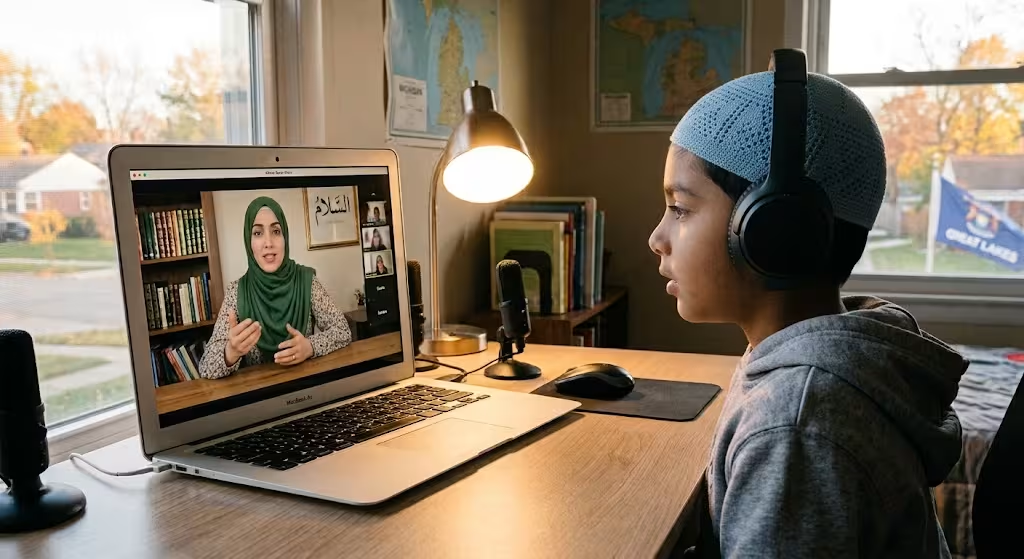
Parents carry the daily habit, but a teacher can correct pronunciation, explain meanings and keep a child moving forward. Many families from Michigan, Illinois and Texas add a few minutes of daily duas for kids to each Quran lesson, so the child reviews them with a teacher every week. Our Islamic Studies course covers duas, wudu and salah for children, and parents of younger learners can explore our Quran classes for children.
To see how it all fits together, compare our online Quran classes in USA and book a free trial. A patient teacher, one dua at a time and a warm home routine are all it takes for duas for kids to become a lifelong habit.