


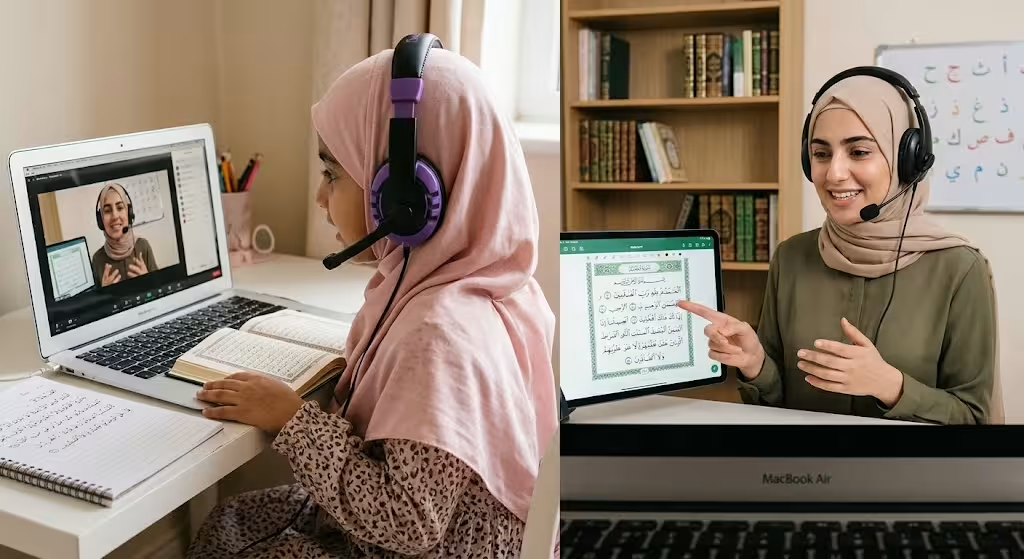
Noorani Qaida lessons take a beginner from the single Arabic letters to reading Quranic words with correct pronunciation. In order, you learn the letters, joined letters, the disjoined letters, the short vowels (harakat), tanween, the standing vowels, madd and leen letters, sukoon, tashdeed, and finally practice with real Quranic phrases. Most children finish in 4 to 8 months and most adults in 2 to 5 months with three short lessons a week.
Noorani Qaida is the small booklet that has taught generations of children, and many adults, to read the Quran. It was compiled by Sheikh Noor Muhammad Ludhianvi, and its strength is its order: every lesson uses only what came before, so a learner never meets a sign they have not been taught.
Parents often ask what their child is actually learning on each page, and adults want to know how far they have to go. This guide walks through the Noorani Qaida lessons one stage at a time, explains what each one teaches and why it matters, and shows how long the whole journey usually takes.
How Noorani Qaida Lessons Are Organized
Different printings number the pages and lessons a little differently. Some have 16 lessons, others 17 or more, and a few combine exercises into the main lessons. The order, however, is the same in nearly every edition. You can think of the Noorani Qaida lessons in five stages:
| Stage | Lessons cover | Main skill |
|---|---|---|
| 1. Letters | Single letters, joined letters, disjoined letters | Recognizing and pronouncing each letter |
| 2. Short vowels | Fatha, kasra, damma and their exercises | Reading syllables |
| 3. Tanween and long vowels | Tanween, standing vowels, madd and leen letters | Reading words with the right length |
| 4. Sukoon and tashdeed | Jazm, shaddah and their combinations | Joining syllables smoothly |
| 5. Practice | Quranic words, phrases and basic rules | Reading real verses |
If your copy numbers things differently, do not worry. Follow the order on the page and your teacher's guidance.
Stage 1: The Letters
Single letters (Huroof Mufradat)
The first lesson presents the 29 letters of the Arabic alphabet one by one. The goal is not just to name each letter but to pronounce it from the right place in the mouth and throat (makharij). Letters that sound alike to English speakers, such as ح and ه, س and ص, or ذ and ز, get extra attention here. For a letter chart grouped by makharij and pair drills with real Quran words, see our guide to learning Arabic letters for Quran reading.
Joined letters (Huroof Murakkabat)
Arabic letters change shape depending on where they sit in a word. This lesson shows pairs and groups of letters joined together, so the learner recognizes a letter at the start, middle and end of a word.
Disjoined letters (Huroof Muqatta'at)
Some Surahs begin with letters read by their names, such as Alif Lam Mim. This lesson practices them, and it is often the first time a learner meets something taken directly from the Quran.
Stage 2: Short Vowels (Harakat)
Next the Noorani Qaida lessons introduce the three short vowels: fatha (a), kasra (i) and damma (u). Each is a quick sound, held for one count. The exercises that follow mix letters and vowels so the learner reads syllables like ba, bi, bu, then short words.
This stage is where good habits form. A teacher listens for vowels that are stretched too long or swallowed, because those errors carry into the Quran.
Stage 3: Tanween and Long Vowels
Tanween
Tanween is a doubled vowel mark that adds an "n" sound at the end of a word: -an, -in, -un. Learners see it everywhere in the Quran, so this lesson gets plenty of practice.
Standing vowels
Some printings use a small vertical fatha, a vertical kasra and an inverted damma. They show that the vowel is held for two counts.
Madd and leen letters
Alif, waw and ya lengthen the vowel before them when they have no vowel of their own. These are the madd letters, the base of every lengthening rule in Tajweed. When waw or ya carry a sukoon after a fatha, they make a soft gliding sound called leen, as in خَوْف and بَيْت. Later, you will build on this with the full Madd rules in Tajweed.
Stage 4: Sukoon and Tashdeed
Sukoon (jazm)
A sukoon means a letter has no vowel, so it closes the syllable before it, as in مِنْ. Reading sukoon well is what makes recitation sound smooth rather than broken into pieces.
Tashdeed (shaddah)
A shaddah means the letter is doubled: you stop on it once and read it again with its vowel, as in رَبِّ. The Qaida then combines shaddah with sukoon and with madd letters, which are some of the hardest pages for beginners.
At this point many learners also meet their first nasal sound (ghunnah) on a doubled noon or meem. These are the doors into the Noon Sakinah and Tanween rules studied in Tajweed.
Stage 5: Practice With Quranic Words
The final Noorani Qaida lessons bring everything together in words and short phrases from the Quran, often with a first look at simple Tajweed signs and where to pause. When a learner reads these pages fluently, they are ready to start reading from the Mushaf, usually beginning with the short Surahs of Juz Amma.
How Long Do Noorani Qaida Lessons Take?
| Learner | Lessons per week | Typical time to finish |
|---|---|---|
| Child aged 4 to 6 | 3 to 5 short lessons | 6 to 10 months |
| Child aged 7 to 10 | 3 to 5 lessons | 4 to 6 months |
| Teen or adult | 3 lessons | 2 to 5 months |
These are typical ranges, not deadlines. In Noorani Qaida lessons, regular practice matters more than speed, and rushing past weak pages only slows down Quran reading later. If you are deciding when your child should begin, our guide on what age a child should start learning Quran can help.
Tips for Practicing Noorani Qaida Lessons at Home
- Five to ten minutes daily beats one long session a week.
- Read aloud, never silently. The skill is in the mouth, not the eyes.
- Point to each letter with a finger or pen to stop skipping.
- Revise the previous page before starting a new one.
- Record and listen. Hearing yourself shows mistakes you miss while reading.
- Do not guess. If a sound is unclear, ask your teacher rather than practicing it wrong.
For more on teaching children, see how to teach Quran to kids at home. For an overview of the book itself and why it suits US learners, read our earlier guide to Noorani Qaida for beginners in the USA.
Learning Noorani Qaida Online
Anyone working through Noorani Qaida lessons needs one thing above all: someone to listen and correct every sound. That is why one-to-one online lessons suit this stage so well. In our online Quran classes for beginners, the teacher listens to every line and fixes errors on the spot, while you or your child read from the screen or a printed Qaida.
Families in Texas, California and Michigan book these lessons after school or work in their own time zone. Adults returning after many years can start here too, without the embarrassment of a group. Compare our online Quran classes in USA and begin with a free trial.