


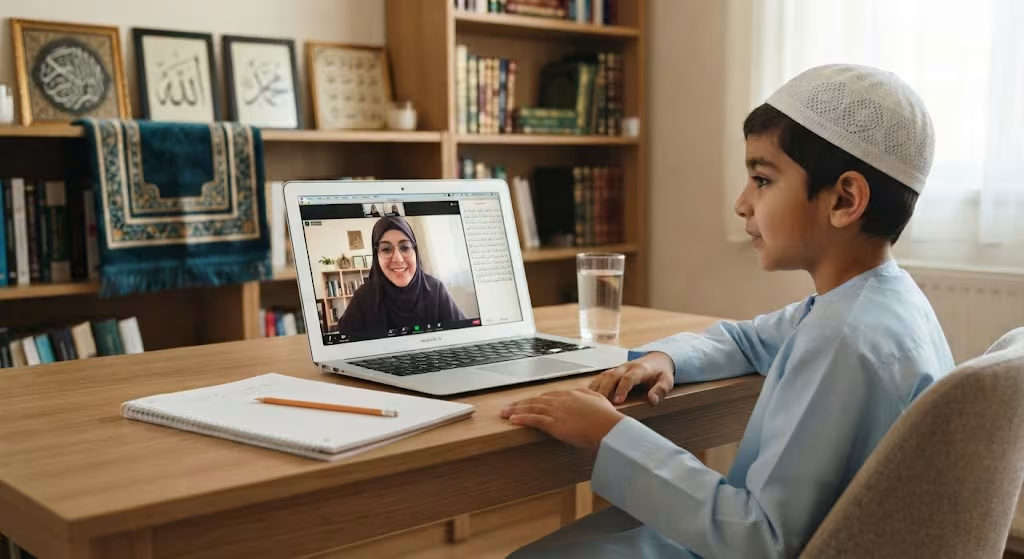
To teach Quran to kids at home, set a fixed daily time, keep sessions short (10 to 20 minutes), start with listening and Noorani Qaida, use praise and small rewards, model recitation yourself, and review a little every day. For correct pronunciation and Tajweed, combine your home routine with a qualified tutor who can correct your child's recitation.
Many parents in the USA want to teach Quran to kids at home but feel unsure where to begin. Some worry their own Arabic is not perfect; others struggle to compete with screens, homework and after-school activities. The good news: you do not need to be a scholar to build a strong Quran habit at home.
These twelve tips come from what works for real families. Some are about routine, some about teaching methods and some about motivation. Use them on their own, or alongside lessons with a tutor.
Before You Begin: What Parents Can and Cannot Do Alone
Parents are the best people to build love, routine and consistency. What is hard to do alone is correct pronunciation and Tajweed, especially if you learned without rules yourself. The most successful families teach Quran to kids at home through routine and encouragement, and let a qualified teacher handle the fine details of recitation.
Tips 1–4: Build the Routine
1. Choose a fixed time
Pick one time every day, such as right after school or after Maghrib. When Quran happens at the same time, children stop negotiating.
2. Keep it short
Ten to twenty minutes is ideal for young children. It is better to teach Quran to kids at home for ten minutes every day than an hour once a week.
3. Create a Quran corner
A quiet spot with the Qaida or Mushaf, a small cushion and good light signals that this time is special.
4. Quran before screens
Make the rule simple: Quran first, then tablets and TV. Energy and focus are higher before screen time.
Tips 5–8: Teach the Right Way
5. Start with listening
Play recitation at home daily. Children who hear the Quran often pick up sounds and short Surahs naturally.
6. Use Noorani Qaida for reading
The Qaida teaches letters, sounds and joining step by step. Our Quran Foundations course follows the same method.
7. Teach small portions
Three new lines learned well beat a whole page learned badly. Repeat each line until it is easy, then move on.
8. Connect words to meaning
Explain simply what a Surah is about. When children understand that Al-Fatiha is a conversation with Allah, they recite it differently.
Tips 9–12: Keep Kids Motivated
9. Praise effort, not just results
"I love how carefully you said that letter" builds more motivation than "good job."
10. Use a progress chart
A simple sticker chart for each completed page or Surah gives children something visible to work toward.
11. Be the example
Children who see parents recite daily want to recite too. Many parents start lessons for themselves alongside their children in our Quran classes for adults.
12. Celebrate milestones
Finishing the Qaida, the first Juz or the first memorized Surah deserves a family celebration.
Fun Ways to Teach Quran to Kids
Young children learn through play. Try letter flashcards, a "find the letter" game on a page of the Qaida, or a family recitation circle where each person reads one line. Short stories of the Prophets after the lesson give children something to look forward to. Fun activities are one of the easiest ways to teach Quran to kids at home without resistance.
Mistakes to Avoid When You Teach Quran to Kids
- Making lessons too long, so they end in tears instead of success.
- Comparing your child with siblings or cousins.
- Using Quran time as a punishment.
- Skipping days, which breaks the habit you worked to build.
- Correcting every small mistake at once instead of one at a time.
Parents who avoid these mistakes find it much easier to teach Quran to kids consistently, and children grow up associating the Quran with warmth rather than pressure.
A Sample Weekly Plan
| Day | Activity (15–20 minutes) |
|---|---|
| Monday | New Qaida lesson or new lines |
| Tuesday | Review Monday, add two lines |
| Wednesday | Listening and short Surah practice |
| Thursday | New lesson |
| Friday | Recite Surah Al-Kahf verses together |
| Weekend | Review the week, story of a Prophet |
When to Bring in a Teacher to Teach Quran to Kids
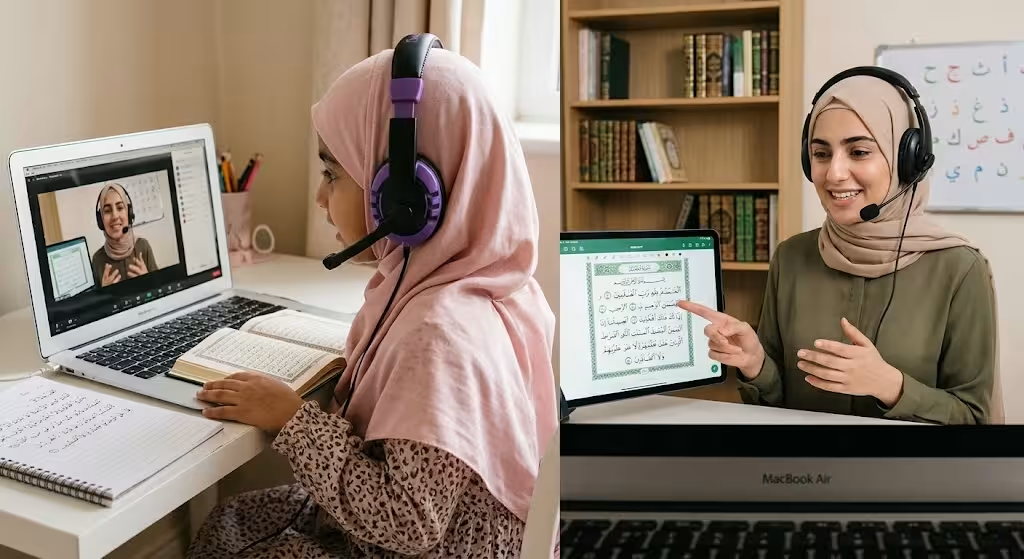
It helps to bring in a teacher when your child starts reading full verses, when Tajweed rules come in, or when you notice pronunciation mistakes you cannot fix. A tutor does not replace your role; it frees you to focus on encouragement. If you are unsure whether your child is old enough, read our guide on when a child should start learning Quran.
Teaching Quran at Home in the USA
American schedules are full, so short daily practice plus a few weekly lessons works best. Families in New Jersey, Illinois and across the country use our online Quran classes for kids to support what they teach at home, with lessons scheduled in their own time zone. Parents of younger children can also see our age-by-age Quran classes for children or browse all our online Quran classes in USA.