


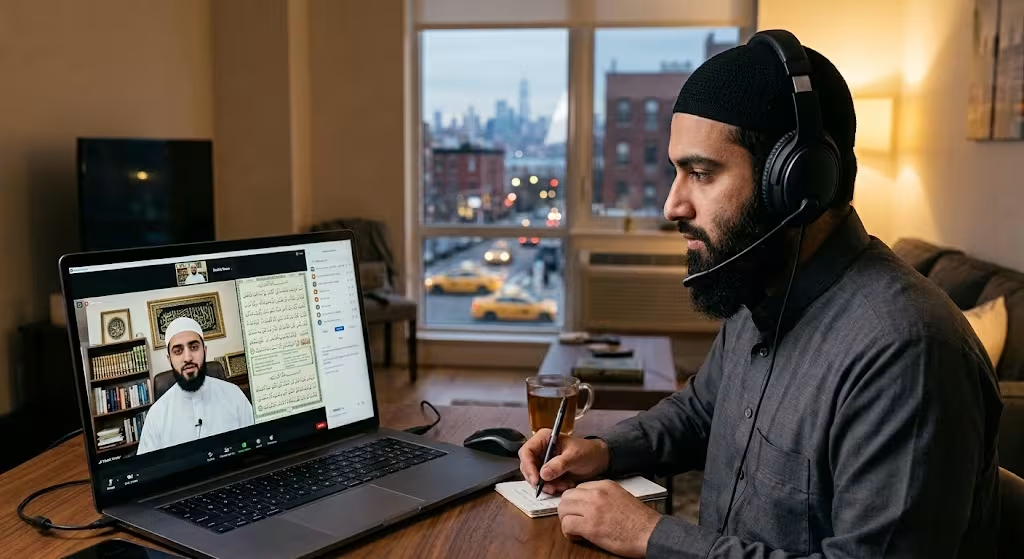
Learning Quran after 40 is realistic for almost everyone. Adults over 40 usually read Arabic within three to six months with two or three 30 minute one-to-one lessons a week and 10 to 15 minutes of daily practice. Memory works differently, not worse: you learn best through meaning, repetition and steady revision. A large-print Mushaf, a patient teacher and a fixed daily time matter more than your age.
Many people reach their forties with the same quiet regret: "I should have learned the Quran properly when I was young." Maybe you went to weekend school as a child and forgot most of it. Maybe you never learned at all, or you embraced Islam as an adult. Now the children are growing, your career is settled, your parents are aging, and the wish comes back stronger than before.
Then the doubts arrive. Is my memory good enough? Will I be embarrassed reading like a child? Do I have the time? This guide answers those questions honestly. It explains what really changes when you start learning Quran after 40, what stays the same, how long progress takes, and how to set up a plan you can keep for years, not weeks.
Is It Too Late? What Islam and Experience Say
It is not too late, and learning Quran after 40 has deep roots in our history. The Quran was revealed to a community of adults. Many of the Companions embraced Islam as grown men and women, some well into middle age, and they learned the Quran then. Learning was never limited to childhood.
The Prophet ﷺ also gave special encouragement to the person who finds reading hard. He said that the one who is skilled in the Quran is with the noble and righteous scribes, and the one who recites it while stumbling and finding it difficult receives two rewards (Sahih al-Bukhari and Sahih Muslim). If you are learning Quran after 40 and every line feels slow, that struggle itself is rewarded.
Our own experience teaching adults across the USA says the same. Some of our most consistent students are in their forties, fifties and sixties. They rarely miss lessons, they ask good questions, and they practice because they chose to be there.
What Actually Changes When You Learn After 40
Learning Quran after 40 goes best when you are honest about age, because a plan that ignores it tends to fail. Here is what usually changes, and how to handle each one:
| What changes | What it feels like | Simple fix |
|---|---|---|
| Near vision | Small Arabic letters and dots blur | Large-print or color-coded Tajweed Mushaf, good lighting, reading glasses |
| Rote memory | New words take more repetitions to stick | Learn meaning first, repeat more, revise daily |
| Hearing of fine sounds | Similar letters (like ث and س) sound alike | Headphones in class, slow listening practice |
| Mouth habits | English sounds are deeply set | Short makharij drills, teacher correction every lesson |
| Energy and time | Long evening sessions feel heavy | 30 minute lessons, early morning practice |
Notice what is not on the list: the ability to learn. Adults have better focus, stronger reasons and more discipline than most children. They understand why a rule exists, not only what it is. That makes learning Quran after 40 different from learning at 8, but in many ways easier.
How Memory Works for Adults (and How to Use It)
Children often memorize by sound alone. Adults remember better when sounds are connected to meaning and structure. Research on adult learning broadly supports this: older learners do well when new material links to what they already know and is reviewed at spaced intervals.
In practice, learning Quran after 40 with an adult memory means:
- Learn the meaning before you memorize. Read a short translation of the Surah first. "Say, He is Allah, the One" sticks faster when you know what you are saying.
- Repeat more than you think you need. If a child needs ten repetitions, give yourself fifteen or twenty without any guilt.
- Revise before you add. Spend the first part of each practice session on yesterday's work. Our guide on how to memorize Quran and never forget explains a daily revision cycle that suits adults well.
- Sleep on it. Practice in the evening and review the next morning. Many adults find the morning review is when things finally click.
Eyesight, Voice and Comfort: Small Things That Matter
Practical details decide whether learning Quran after 40 feels pleasant or frustrating.
Choose the right Mushaf. A large-print Mushaf with clear dots makes a huge difference. Color-coded Tajweed editions also help, because the colors remind you of rules your eyes might miss. During online lessons, your teacher can zoom the shared screen as large as you need.
Set up your space. Sit at a table with good light, not on a couch late at night. Keep your glasses, Mushaf, notebook and headphones in one place so starting a lesson takes seconds.
Look after your voice. Arabic uses the throat more than English does. Short practice sessions with water nearby are better than one long session that leaves your throat sore. Your teacher will build up difficult letters slowly.
Stay comfortable. If sitting for long is hard on your back or knees, use a chair and take a short break mid-lesson. Comfort is not a lack of seriousness.

A Realistic Timeline by Goal
Every adult is different, but these ranges are typical for learning Quran after 40 for students who take two or three 30 minute lessons a week and practice daily:
| Goal | Starting point | Typical time |
|---|---|---|
| Read Arabic letters and short words | Complete beginner | 2 to 4 months |
| Read the Mushaf slowly but correctly | Finished Noorani Qaida | 4 to 8 months |
| Correct Tajweed in daily recitation | Can already read | 6 to 12 months |
| Memorize the short Surahs of Juz Amma | Can read with basic Tajweed | 6 to 12 months |
| Understand what you recite in Salah | Any level | Ongoing, alongside reading |
If you once learned as a child, expect faster progress. Old knowledge returns surprisingly quickly once a teacher gives it structure. For a step-by-step route from the alphabet onward, see our guide to learn Quran as an adult beginner, and if your main goal is Tajweed, read how long learning Tajweed takes.
A Weekly Plan for Learning Quran After 40
Most adults over 40 are juggling work, teenagers, aging parents and their own health. A good plan for learning Quran after 40 respects that. Here is a simple weekly rhythm that works for many of our students:
- Monday, Wednesday and Saturday: a 30 minute one-to-one lesson. Choose a fixed time, such as 6:30 am before work or 8:30 pm after dinner.
- Every day: 10 to 15 minutes of practice, ideally right after Fajr or another prayer, so it attaches to a habit you already have.
- On the commute or a walk: listen to the Surah you are learning, recited slowly by a clear reciter.
- Once a week: read a short Tafseer of one passage you studied, so the words carry meaning.
- Once a month: a short review with your teacher to check progress and adjust the plan.
Because lessons are online and scheduled in your own time zone, a professional in Houston and a retiree in New York can both choose the hour that suits them. Students join us from online Quran classes in Texas to online Quran classes in New York and every state in between.
Getting Past Embarrassment
For many adults, the hardest part of learning Quran after 40 is not memory. It is pride. Reading slowly in front of others, or starting from "Alif, Baa, Taa" at 45, can feel humbling.
This is where private lessons help most. In our online Quran classes for adults, it is just you and one teacher. No classmates, no children watching, and the camera is optional. Teachers who work with older students know that a few nervous lessons are normal, and they will not rush you.
It also helps to remember who you are learning for. Nobody reviews your progress except you, your teacher and Allah, who rewards the effort itself. Adults who embraced Islam later in life often feel this most strongly, and our guide on learning Quran as a revert has more encouragement for that path.
Choosing a Teacher for Older Adult Learners
The right teacher makes learning Quran after 40 feel natural. Look for:
- Patience and respect. A teacher who explains instead of drilling, and treats you as an adult.
- Strong Tajweed and clear pronunciation. You are building habits for the rest of your life, so they should be correct.
- A plan based on your goal. Reading for Salah, fixing Tajweed, memorizing or understanding meaning each need a different path.
- Flexible scheduling. Doctor visits, travel and family needs happen. Rescheduling should be easy.
- A male or female teacher by your preference. Many sisters prefer a female teacher, and that should always be available.
- A free trial, so you can judge the teaching style before committing.
Beyond Reading: Making the Quran Part of Your Life
For many people, learning Quran after 40 is about more than reading correctly. It is about finally understanding the words they have said in Salah for decades. Once reading is comfortable, adding translation and Tafseer turns practice into reflection. Our Quran translation course is a natural next step for adults who want meaning alongside recitation.
You may also become the person who teaches your grandchildren their first Surahs. A grandparent learning Quran after 40 and reading it at home leaves a deeper mark than any app.
Start Where You Are
You do not need to catch up on lost years. You only need to start, and to keep going a little each day. Learning Quran after 40 rewards steady effort far more than talent or a young memory.
Explore our Quran lessons for adults over 40 to see plans and teachers, or compare all our online Quran classes in USA and book a free trial at a time that suits your day.