



For most learners, one-on-one Quran classes are the better choice, especially for children, complete beginners and anyone working on Tajweed or Hifz, because the teacher hears and corrects every letter and sets the pace for one person. Group classes cost less and add peer motivation, so they suit siblings or friends at the same level, Islamic studies and tafseer discussions, and confident readers who mainly want routine.
Once a family decides to learn the Quran online, the next question comes fast: should you book one-on-one Quran classes with a private teacher, or join a small group class? Prices, schedules and academy websites all look similar, and every provider seems to say its format is best.
The truth is that both formats work, but they work for different people. This guide compares one-on-one Quran classes and group classes on the points that actually decide results: recitation time, correction, pace, cost, motivation and fit by age and goal. At the end you will find a simple decision table and a hybrid plan many American families use.
What Is the Difference Between One-on-One Quran Classes and Group Classes?
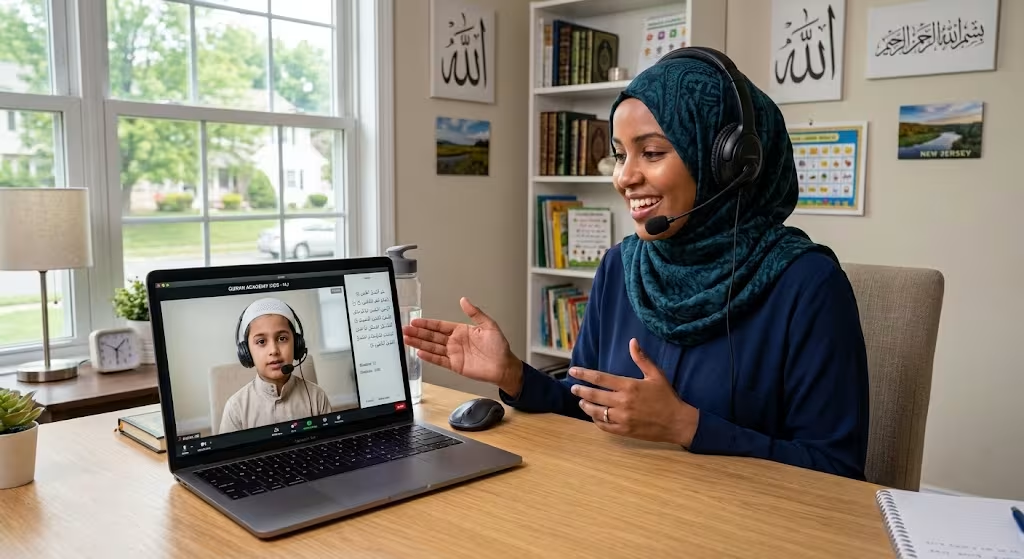
In one-on-one Quran classes, one student meets one teacher, usually by video call, for 30 to 45 minutes. The whole lesson is built around that student: the Surah they are on, the mistakes they make and the goal they set, whether that is reading fluently, perfecting Tajweed or memorizing Juz Amma.
In a group class, one teacher leads three to ten students (sometimes more) through the same lesson. Everyone follows one syllabus and one pace. Students take turns reciting while the others listen, and the teacher corrects each person in their turn.
Neither format is new. The traditional Quran circle (halaqah) in a masjid is a group setting, and yet even there a student usually recites alone to the teacher to have their reading checked. That one-to-one moment of listening and correcting has always been at the heart of Quran teaching, because the Quran is learned by hearing it from a teacher, just as the Companions learned it from the Prophet ﷺ.
One-on-One vs Group Quran Classes: Side-by-Side Comparison
| Factor | One-on-one Quran classes | Group Quran classes |
|---|---|---|
| Recitation time per student | Most of the lesson | A few minutes per turn |
| Correction | Every mistake, right away | Main mistakes, when it is your turn |
| Pace | Set for one learner | Set for the middle of the group |
| Schedule | Chosen around your day | Fixed class time |
| Cost per student | Higher | Lower |
| Peer motivation | Comes from the teacher and parent | Built in |
| Best for | Kids, beginners, Tajweed, Hifz, shy learners | Same-level siblings, Islamic studies, discussion |
Why Many Families Choose One-on-One Quran Classes
More recitation, more correction
Quran reading is a skill you build with your tongue and ears, not by watching. In a 30-minute private lesson a student may recite for 20 minutes or more. In a group of six, the same 30 minutes can mean only a few minutes of reciting for each person. Over a month, that gap adds up to many hours. This is the main reason one-on-one Quran classes usually move faster, especially in learning Tajweed online, where small errors in a letter's sound or length have to be heard and fixed every time.
A pace that fits one person
A seven-year-old who needs three lessons for the letters with dots, and an adult revert who already reads transliteration quickly, should not be in the same class. Private lessons let the teacher slow down on a hard rule, skip what the student already knows and change the plan when life gets busy, such as during finals week or Ramadan.
Flexible timing across US time zones
Group classes run at one fixed time. One-on-one Quran classes can be booked before school, after soccer practice or after the kids are asleep, in Eastern, Central, Mountain or Pacific time. For working parents and university students, that flexibility is often what keeps the habit going. Our guide to online Quran classes across US time zones lists the best lesson slots for each zone.
Comfort for shy learners and adults
Many adults feel embarrassed to read slowly in front of strangers, and many children go quiet in a group. A private setting removes that pressure. It also makes it easy to choose a teacher you are comfortable with; see our guide on how to find a female Quran teacher online if that matters for your family.
Parents can see real progress
With one student per lesson, progress is easy to track: which Surah, which rule, which mistakes keep coming back. Parents can sit in, and the teacher can give clear feedback about one child instead of a general class report.
When Group Quran Classes Make Sense
Group lessons are not a bad choice. They are simply a different tool, and in some situations they work well:
- Siblings or friends at the same level. Two cousins starting Noorani Qaida together can push each other and share the cost.
- Islamic studies, Seerah and tafseer discussions. These subjects are about understanding and discussion, so hearing other people's questions adds value.
- Confident readers who want routine. A student who already reads with good Tajweed may only need a regular class to keep reading.
- Social motivation. Some teens show up more reliably when friends are in the class too.
- Tight budgets. A group lowers the cost per student, which can be the difference between learning and not learning at all.
The main downsides are less recitation time, a fixed pace, a fixed schedule and mistakes that can slip through when the teacher has to move on to the next student.
Which Format Is Best by Age and Goal?
| Learner | Better fit | Why |
|---|---|---|
| Kids 4 to 7 | One-on-one | Short attention span, needs a teacher's full focus |
| Kids 8 to 12, beginners | One-on-one | Letters and Tajweed need constant correction |
| Kids 8 to 12, same-level siblings | Small group or family plan | Shared lesson, shared motivation |
| Teens | One-on-one, or group for Islamic studies | Privacy for reading, peers for discussion |
| Adult beginners and reverts | One-on-one | Comfort, own pace, no pressure |
| Tajweed students | One-on-one | Every sound must be checked |
| Hifz students | One-on-one | Daily new lesson and revision are personal |
| Tafseer and Islamic studies | Group works well | Discussion and questions help everyone |
If you are unsure how often your child should attend either format, our guide to how many Quran classes per week for kids gives schedules by age.
Cost: Are One-on-One Quran Classes Worth It?
Group classes usually cost less per student, and that matters for families with several children. But compare cost against results, not just the monthly fee. If a group student needs twice as long to finish Noorani Qaida or to fix the same Tajweed mistakes, the cheaper class can cost more in the end, both in money and in motivation.
At our academy, one-on-one Quran classes start at $40 a month for three 30-minute lessons a week, with discounted family packages for siblings and group options for brothers, sisters or friends learning together. The full breakdown is on our fee page, and our article on online Quran classes cost in USA explains what drives prices across academies.
A Hybrid Plan Many Families Use
You do not always have to choose one or the other. A common pattern among our US families looks like this:
- Core skill in private lessons. Reading, Tajweed or Hifz three to five days a week in one-on-one Quran classes.
- Knowledge in a group. Islamic studies or a tafseer circle once a week with siblings or friends, online or at your local masjid.
- Practice at home. Ten minutes a day of listening and revision, guided by the teacher's notes.
Families in Texas, California, New Jersey and Illinois often pair evening private lessons with a weekend program at their masjid. If you are weighing that choice, read our comparison of online Quran classes vs local Quran schools, or our state guide to Quran classes for kids in Texas.
5 Questions to Ask Before You Decide
- What is the main goal? Reading, Tajweed and Hifz point to one-on-one Quran classes; general knowledge can work in a group.
- How many students per group? More than five usually means very little recitation time for each one.
- Is everyone at the same level? A mixed group slows down the fast learner and loses the slow one.
- How is progress reported? Ask for regular updates, not just attendance.
- Can you switch formats? A good academy lets you move between private and group lessons as needs change.
The Bottom Line
For most children, beginners, Tajweed students and anyone memorizing the Quran, one-on-one Quran classes give the fastest and most accurate progress because every minute is built around one learner. Group classes are a sensible, affordable choice for same-level siblings, discussion subjects and confident readers who need routine. The best plan is the one your family will keep up week after week. Compare our online Quran classes in USA, book a free trial and see the difference a private teacher makes.