


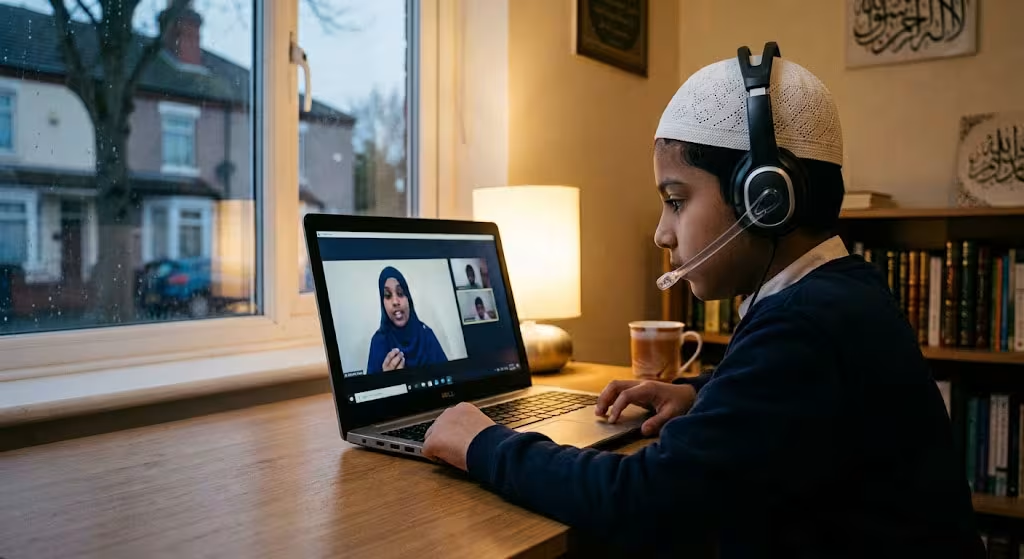
Most children do best with three to five Quran classes per week. Children aged 4 to 6 need short lessons of 20 to 30 minutes, three or four times a week. Ages 7 to 10 do well with 30-minute classes four or five times a week. Ages 11 to 14 can handle 30 to 45 minutes, four or five days a week, and children doing Hifz usually need five or six lessons a week. Consistency matters more than length.
"How many Quran classes per week should my child take?" is one of the first questions parents ask us. Too few Quran classes per week and progress stalls; too many and a child gets tired, especially after a full school day.
The right number depends on your child's age, their stage (Noorani Qaida, reading with Tajweed or Hifz) and your family's weekly routine. This guide gives clear schedules by age, the ideal length of each lesson and sample weekly plans that fit around American school days.
Why Frequency Matters More Than Length
Children learn to read the Quran the way they learn any new skill: through short, frequent practice. Four short Quran classes per week of 25 minutes build far more fluency than one long two-hour session on Saturday, because letters, sounds and rules are revisited before they fade.
Frequent lessons also make Quran a normal part of the week rather than a big weekend task. When the class happens at the same time on the same days, children stop negotiating and simply show up.
Recommended Quran Classes Per Week by Age
| Age | Classes per week | Lesson length | Typical stage |
|---|---|---|---|
| 4–6 years | 3–4 | 20–30 minutes | Arabic letters, Noorani Qaida |
| 7–10 years | 4–5 | 30 minutes | Qaida to Quran reading, basic Tajweed |
| 11–14 years | 4–5 | 30–45 minutes | Fluent reading, Tajweed rules, short Surahs |
| Any age, Hifz | 5–6 | 45–60 minutes | Sabaq, Sabqi and Manzil |
These are starting points, not fixed rules. A focused seven-year-old may be ready for five Quran classes per week, while a busy twelve-year-old with sports may do better with four longer ones.
Ages 4 to 6: short and playful
Young children have short attention spans. Three or four Quran classes per week of 20 to 30 minutes are plenty. Lessons should mix letter recognition, sounds, short Surahs and a little fun. If you are not sure your child is ready, our guide on what age a child should start learning Quran explains the signs. For the very youngest learners, see Quran classes for toddlers.
Ages 7 to 10: building reading fluency
This is the stage where most children move from Noorani Qaida to reading from the Mushaf. Four or five 30-minute Quran classes per week keep the momentum going. Children at this age benefit most from daily contact with the text, even on days without a class.
Ages 11 to 14: depth and Tajweed
Older children can concentrate longer and start applying Tajweed rules consistently. Four or five Quran classes per week of 30 to 45 minutes work well. Many students at this age also begin memorizing selected Surahs or join a part-time Hifz track.
How Long Should a Kids' Quran Class Be?
For most children, 30 minutes is the sweet spot. It is long enough for a warm-up, new learning, practice and quick revision, but short enough to end before attention drops.
A well-run 30-minute lesson usually looks like this:
- Two to three minutes of revision of the last lesson.
- Ten to twelve minutes of new material.
- Ten minutes of guided reading with correction.
- Five minutes of recap and a small practice task for the next day.
Lessons longer than 45 minutes rarely help young learners. If your child needs more time, increase the number of Quran classes per week rather than lengthening each one.
Fitting Quran Classes Around the US School Day
Most American families schedule Quran lessons in one of three windows:
- After school (4–7 pm local time): the most popular slot. A short snack and break first helps children arrive focused.
- Before dinner or early evening: good for children with afternoon sports or activities.
- Weekend mornings: ideal for a longer revision lesson or for families who cannot fit weekday classes.
Because lessons are online, the tutor adjusts to your time zone, whether you are in Eastern, Central, Mountain or Pacific Time. Remember to confirm class times when Daylight Saving Time starts and ends, as this is the week when most missed lessons happen. Our scheduling guide to Quran classes in US time zones has a chart for every zone.

Sample Schedules: Quran Classes Per Week in Practice
Plan A: Beginner (ages 5–8)
| Day | Activity | Time |
|---|---|---|
| Monday | Live class: letters and Qaida | 25 min |
| Tuesday | 10-minute practice with a parent | 10 min |
| Wednesday | Live class: new lesson | 25 min |
| Thursday | 10-minute practice | 10 min |
| Saturday | Live class: revision and a short Surah | 25 min |
Plan B: Reader (ages 8–12)
| Day | Activity | Time |
|---|---|---|
| Monday to Thursday | Live class: reading with Tajweed | 30 min |
| Saturday | Revision and recitation test | 30 min |
| Daily | Read one page aloud at home | 10 min |
Plan C: Part-time Hifz (ages 9–14)
| Day | Activity | Time |
|---|---|---|
| Monday to Friday | Live class: Sabaq, Sabqi and Manzil | 45 min |
| Saturday | Weekly revision of the whole portion | 45 min |
| Daily | Listening and self-revision | 15 min |
To choose between a part-time and full-time Hifz track, read our comparison of part-time vs full-time Hifz programs.
Signs the Schedule Needs Adjusting
Watch for these signals during the first month:
- Too many Quran classes per week: your child is tired, resists every lesson or makes the same mistakes repeatedly. Our guide on helping kids enjoy Quran time shows how to turn resistance around.
- Too few Quran classes per week: your child forgets last week's lesson and each class starts with re-teaching.
- Wrong time of day: your child is hungry, distracted or rushing to another activity.
Small changes, such as moving a class 30 minutes later or swapping one weekday for Saturday, often fix the problem without reducing progress.
Practice Between Classes
Live lessons give structure, but daily contact with the Quran is what builds fluency. Ten minutes of reading aloud on non-class days doubles the value of each lesson. Parents do not need to be experts; listening, encouraging and keeping the routine is enough. Our guide on how to teach Quran to kids at home has simple activities for these practice days.
How Many Quran Classes Per Week Do Siblings Need?
Siblings usually need separate lessons, because they are rarely at the same level. Scheduling them back to back (for example 5:00 and 5:30 pm) keeps the evening simple. Online classes are also easy to supervise: our parent checklist on whether online Quran classes are safe for kids explains what to look for.
Choosing Online Quran Classes for Kids in the USA
Families in New York, Texas, California and across the country choose online lessons because they fit the school week without a drive to the masjid. If you live in NYC or elsewhere in the state, our guide to Quran classes for kids in New York compares masjid weekend schools with online lessons. Our online Quran classes for kids start with a free trial, where the tutor assesses your child's level and recommends how many Quran classes per week will work best. For a full age-by-age program, see online Quran classes for children, or explore all our online Quran classes in USA.