


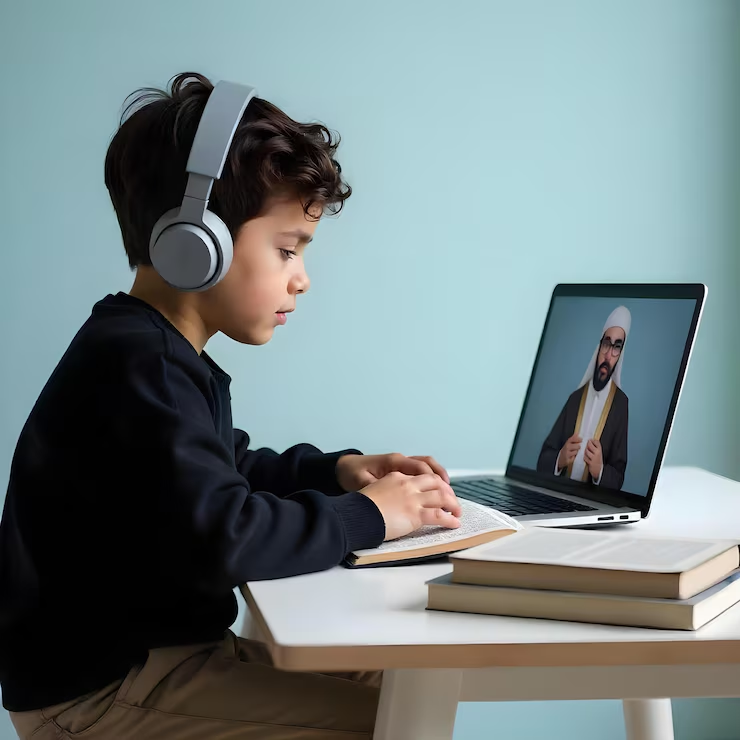
Quran apps are excellent for listening, reading a digital Mushaf, looking up translations and practicing every day, but on their own they rarely teach a beginner to recite correctly. Live online Quran classes give you a qualified teacher who hears your recitation, corrects letters and Tajweed in real time, and keeps you on a plan. For most US families the answer is both: a teacher two to five times a week for learning, and apps for the minutes in between.
Open the App Store or Google Play and you will find hundreds of Quran apps: digital Mushafs, audio players with famous reciters, Noorani Qaida games for kids, memorization trackers and newer apps that claim to check your recitation with AI. Many are free. So it is a fair question for any parent or adult learner: why pay for online Quran classes when a phone can do so much?
The short answer is that apps and teachers do different jobs. This guide compares them goal by goal (reading, Tajweed, memorization and kids), looks at the real yearly cost for an American family, explains what AI recitation checkers can and cannot hear, and gives you a weekly plan that gets the best out of both.
What Quran Apps Do Well
Good Quran apps have made daily contact with the Quran easier than ever. These are the jobs they do very well:
- A Mushaf in your pocket. You can read on the bus, in a waiting room or during a lunch break, in the same page layout as your printed copy.
- Listening to expert reciters. Hearing a slow, clear Qari before you read is one of the best habits a learner can build, and apps make it free.
- Translation and word-by-word meaning. Many apps show English meanings under each word, which helps you understand what you recite.
- Reminders and streaks. A daily notification can turn "I will read later" into ten minutes every evening.
- Repeat loops for memorization. Setting one verse to play five or ten times is a simple, effective Hifz tool.
For a learner who can already read with correct Tajweed, these features are a real blessing. The trouble starts when Quran apps are used as the teacher instead of the helper.
Where Quran Apps Fall Short
No one hears your mistakes
Recitation is a spoken skill. The difference between a heavy and a light letter, a missing Ghunnah or a stretched vowel is often tiny, and a beginner cannot hear their own error. Most Quran apps play the correct sound perfectly, but they do not listen back. You can repeat a mistake a thousand times and the app will still show a green check mark for "lesson complete."
AI recitation checkers are improving, but limited
A new group of Quran apps uses speech recognition to follow your recitation and flag missed or wrong words. That is useful for memorization, because it catches a skipped verse. Fine Tajweed is a different story. Rules like Ikhfa, Qalqalah and the exact length of Madd depend on subtle sound details, accents and microphone quality, and current tools can miss real errors or flag correct recitation. Treat AI feedback as a second pair of ears, not as your teacher.
No plan that adapts to you
An app gives everyone the same lesson order. A teacher notices that your child confuses two letters, that you rush the end of every verse, or that your week is packed with exams, and changes the plan. That personal adjustment is where most progress comes from.
Motivation fades
Download numbers are huge, but daily use of most learning apps drops sharply after the first few weeks. A scheduled class with a real person, who expects you on Tuesday at 5 p.m., keeps people going long after the excitement of a new app is gone.
Online Quran Classes vs Quran Apps: Side by Side
| Factor | Quran apps | Live online Quran classes |
|---|---|---|
| Cost | Free to about $10 a month | Monthly fee, based on lessons per week |
| Correction of mistakes | None or automated | Live, letter by letter |
| Tajweed accuracy | Shows the rule, cannot judge you | Teacher hears and fixes it |
| Personal plan | Same path for everyone | Built around your level and goal |
| Accountability | Notifications | A teacher who expects you |
| Flexibility | Any time, any place | Fixed slots in your time zone |
| Best use | Listening, reading, revision | Learning, correcting, progressing |
Neither column wins on every row. That is exactly why the strongest learners use both.
Which Works Better for Your Goal?
Learning to read from zero
For a complete beginner, Quran apps alone are the weakest option. Arabic letters have sounds that do not exist in English, and a wrong habit formed in Noorani Qaida follows a student for years. A teacher for the first few months is worth it; apps can then help with daily review. Our guide to the best way to learn Quran online explains the steps from the alphabet to fluent reading.
Tajweed
Tajweed apps are good for learning the names of the rules and seeing them color-coded on the page. Applying them correctly needs someone to listen. If Tajweed is your goal, see how live lessons work in our guide to learning Tajweed online.
Memorization (Hifz)
Here Quran apps are genuinely helpful: repeat loops, progress trackers and speech-based word checks all support Hifz. But a Hafiz teacher is still needed to hear the new lesson, test revision and stop small mistakes from being memorized for life.
Kids
Children love colorful Quran apps, and short games can make the alphabet fun. Young kids also need a real voice, praise and gentle correction, and parents need to watch screen time. For a balanced home routine, read how to teach Quran to kids at home.

The Real Cost for a US Family
Free Quran apps cost nothing, and paid apps usually run from a few dollars to about ten dollars a month. One-to-one online Quran classes cost more, but the comparison is not simply app versus class. A family that uses only apps for a year and ends up with a child who reads with fixed mistakes often pays twice: once in lost time and again for a teacher to undo the habits. If you are also weighing a private tutor against a cheaper group class, our guide to one-on-one vs group Quran classes compares the two formats.
A practical way to think about it: many American families already pay for weekly piano, soccer or math tutoring. Two or three 30-minute Quran lessons a week sit in the same range, and siblings can often share a plan. You can compare plans on our fee page.
Safety and Privacy Questions to Ask
Whether you choose Quran apps, classes or both, check a few things before your child starts:
- Ads and in-app purchases. Some free Quran apps show ads that are not suitable for children. Use kid modes and turn off purchases.
- Data collection. In the US, apps aimed at children under 13 must follow COPPA rules on collecting personal data. Read the privacy policy.
- Live classes. Ask whether a parent can sit in, whether lessons are recorded, and how teachers are screened. Our guide on whether online Quran classes are safe for kids has a full checklist.
A Simple Plan That Uses Both
Here is a weekly routine that works for many families from Texas to California:
| Day | Live class (30 min) | App practice (10 to 15 min) |
|---|---|---|
| Monday | New lesson with teacher | Listen to the lesson's verses |
| Tuesday | None | Read the new lesson twice |
| Wednesday | Teacher checks and corrects | Repeat loop on hard verses |
| Thursday | None | Read with word-by-word meaning |
| Friday | Review and next lesson | Listen to a favorite reciter |
| Weekend | None | Short revision with a parent |
The teacher sets the target and fixes mistakes; Quran apps fill the gaps so the lesson is fresh at the next class. Families in New York and Illinois often schedule lessons right after school, around 4 to 6 p.m. local time, with app practice after dinner.
The Reward of Learning From a Teacher
The Prophet (peace be upon him) said, "The best of you are those who learn the Quran and teach it" (Sahih al-Bukhari). He also said that the one who is skilled in the Quran will be with the noble, righteous scribes, and the one who recites it with difficulty, stumbling over it, receives a double reward (Bukhari and Muslim). Struggling to read correctly is not something to hide behind an app; it is something to bring to a teacher, with the promise of reward along the way.
So, What Actually Works?
Quran apps work best as a tool, and live online Quran classes work best as the guide. If you already read fluently with Tajweed, a good app may be enough for daily reading. If you or your child are still learning to read, working on Tajweed or memorizing, a qualified teacher is what turns screen time into real progress.
When you are ready, explore our online Quran classes in USA with male and female tutors, flexible US time zones and a free trial lesson, and keep your favorite apps for practice between classes.